Monday, May 14, 2018

7 Reasons Why Nobody is Reading Your Content and How to Grab Their Attention

Something every woman should know - WHY MEN LIE!

Content, content, content.

It seems like content is the only thing anyone can talk about these days.

You’ve probably read post after post about how “content is king” at least a dozen times.

However, despite your best efforts, you can’t seem to see what the content hype is all about.

You write blog posts.

You create videos.

You participate in social media.

And yet, crickets.

You’re creating content, but it’s not getting you very far.

Unfortunately, creating content isn’t enough to really market your business.

If no one is engaging with what you’re producing, you’re simply wasting time, energy, and resources to clutter an already overcrowded web.

But this doesn’t mean content marketing is ineffective.

In fact, 20% of business owners believe content marketing will have the largest impact on their business in 2018.

If you’re not getting results from the content you’re creating, it typically means you’re doing something wrong.

But with a projected 16% growth rate between 2017 and 2021, content marketing isn’t something you can just hope will pass by.

If you want to market your business successfully, you need to find your errors, shape up your content, and start getting conversions.

To help you improve your content marketing strategy, here are seven of the biggest mistakes you might be making – and what you can do to turn your results around.

1. You have no strategy

Are you posting whatever you want, whenever you want?

A lot of marketers do this.

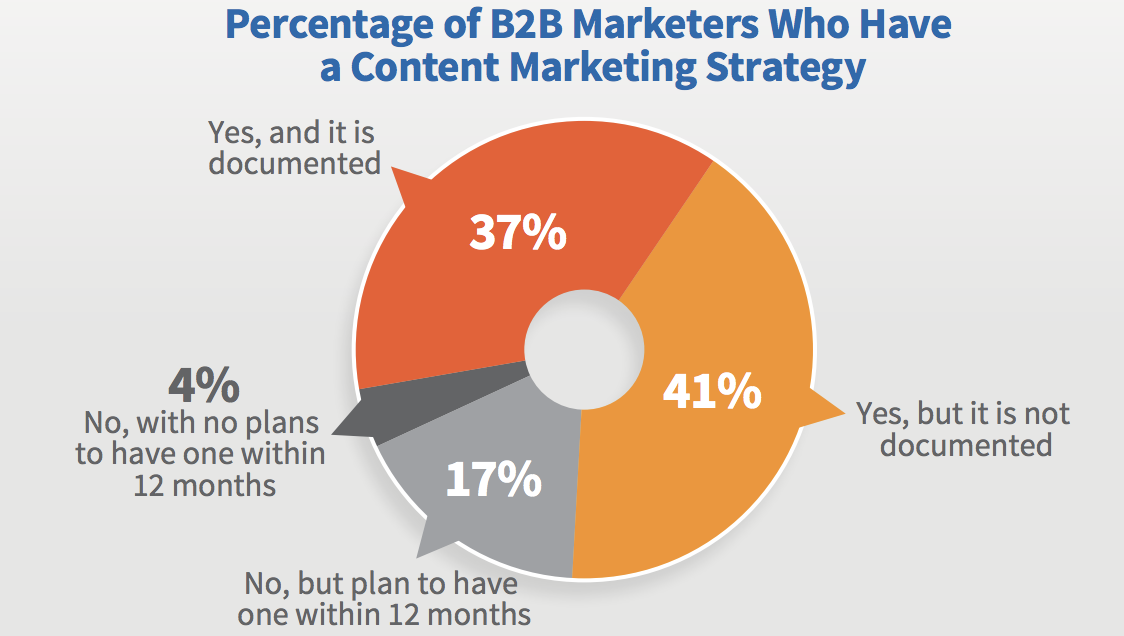
In fact, only 37% of B2B marketers have a documented content marketing strategy.
percentage of b2b marketers who have a content strategy

This means the majority of marketers aren’t thinking strategically about the content they’re creating.

This makes it easy for your audience to ignore whatever you’re sharing.

A content marketing strategy helps you identify what you’d like to accomplish with your content, as well as how you’re going to use your content to achieve your larger business goals.

In other words, it forces you to put intention behind your content.

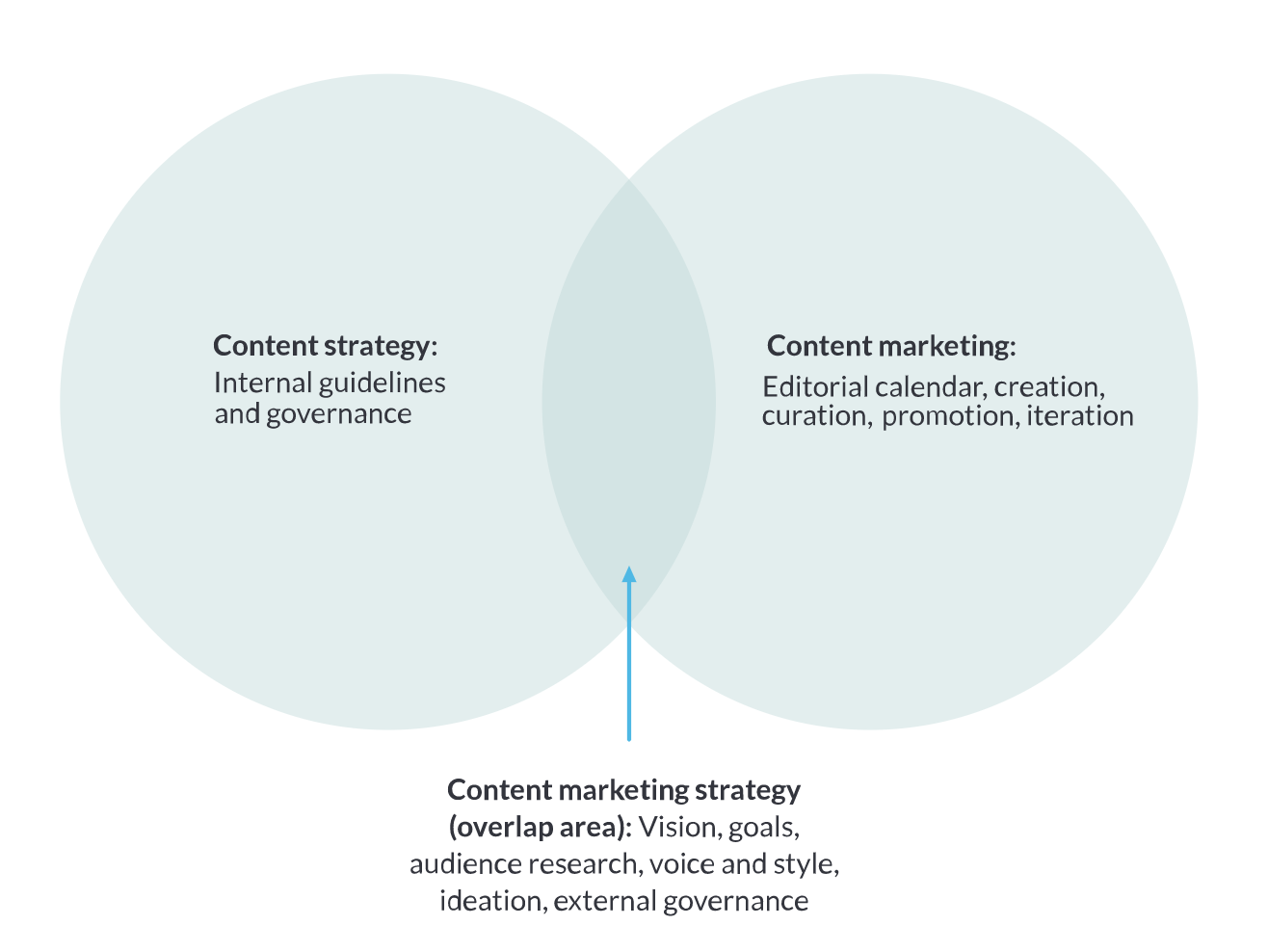
Moz describes content marketing strategy as the overlap between content marketing and content strategy.
moz content marketing strategy

At this intersection, you’re able to use the content you’ve created to bring your business plans to life.

If you’re operating without a content marketing strategy, this disconnect makes it difficult for your target audience to know what you want them to do.

However, when you create a plan, you’re putting a purpose behind your content.

Creating a content marketing plan doesn’t need to be difficult.

In fact, Content Marketing Institute outlines how you can create an effective plan in just one page by outlining your objectives, goals, metrics, and strategy.

Once this is done, you’re ready to move on to an editorial calendar.

Your editorial calendar should work hand-in-hand with the content marketing strategy you’ve created.

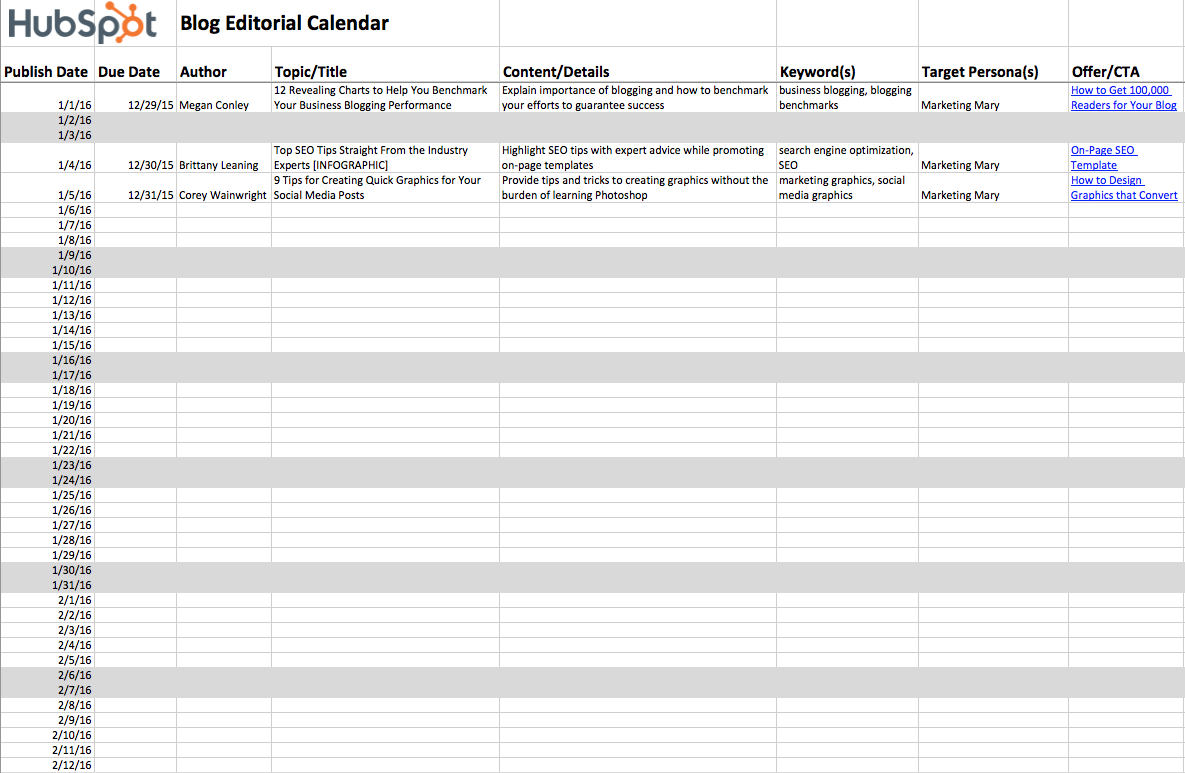
Here’s an example of an editorial calendar template from HubSpot.
hubspot blog editorial calendar

This calendar breaks down exactly when you’re going to publish your blog post, as well as the title name, content details, and keywords you’re going to target.

It also shares which personas you’re trying to reach and what you’re going to offer them.

This kind of well thought out planning means each piece of content you upload fits within the content marketing plan you’ve established.

There are dozens of ways you can create an editorial calendar.

Quickbooks chooses to house their editorial calendar in Airtable – allowing one editor to manage over 4,000 pieces of content.
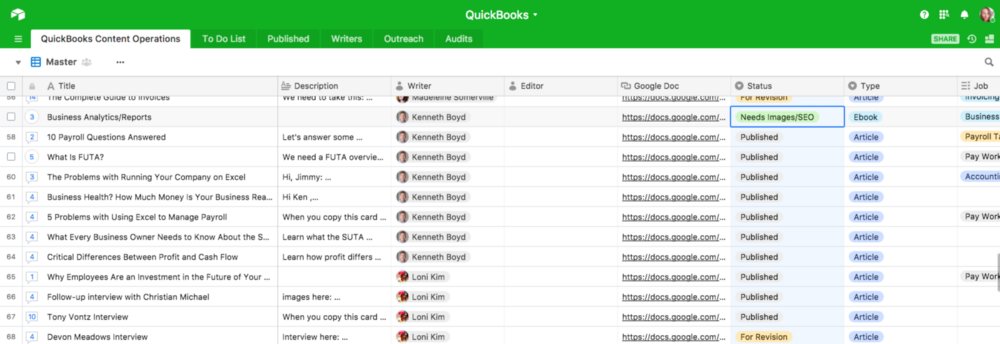
quickbooks content operations

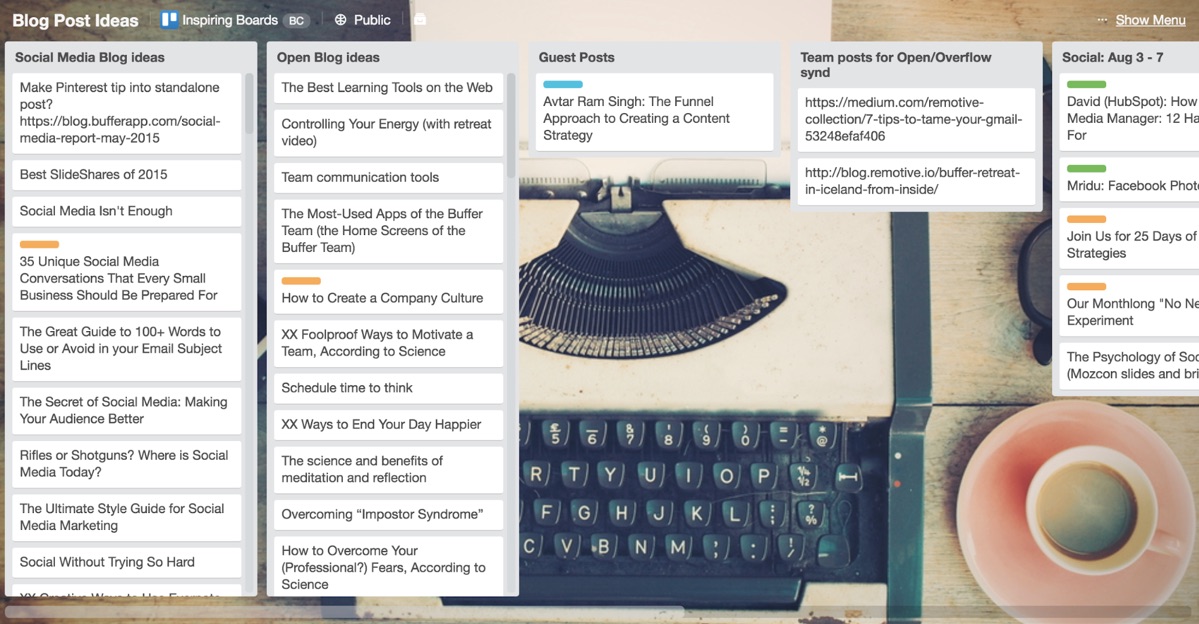
Others, like Buffer, turn to Trello.

buffer blog posts trello

Personally, I like Asana.

But the tool isn’t the point. The best tool is ultimately the one you can get everybody to use consistently.

2. You’re not publishing enough

When it comes to uploading content, quality beats quantity any day.

However, if you’re just posting once a month, you’re going to struggle to grab any real attention.

Consistency is key to building trust and credibility both with your audience and with search engines.

The idea is simple.

When you create more blogs, you’ll drive more traffic to your website.

With more traffic, you can prove to Google that you have content people want to read.

Once they understand you’re sharing valuable information, they’ll give your content a boost on their results pages – bringing in even more traffic and attention.

However, it’s easier said than done.

If you’re stuffing your website with low-quality information that your audience doesn’t care about, it doesn’t matter how frequently you post.

In fact, The Writing Cooperative found that blogging every day actually decreased their views compared to when they were posting just six times a month.

In March 2017, before their posting experiment, The Writing Cooperative was getting about 14,000 views each month.
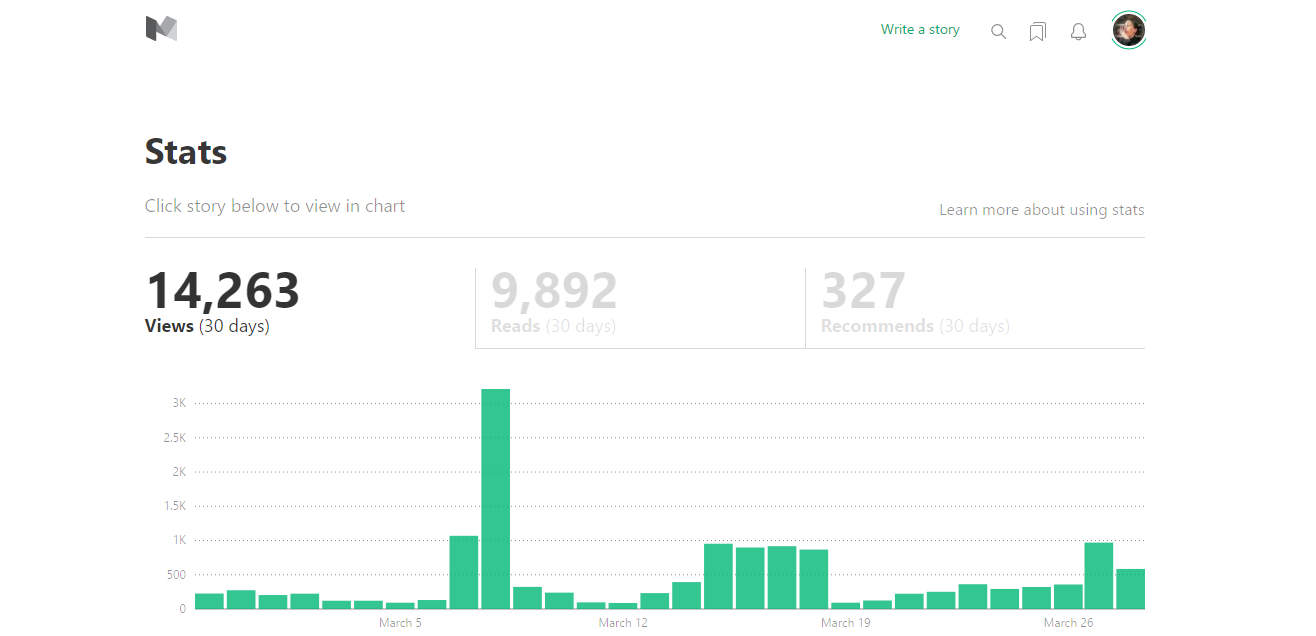
medium stats

But once they began blogging every day, views began to decrease.
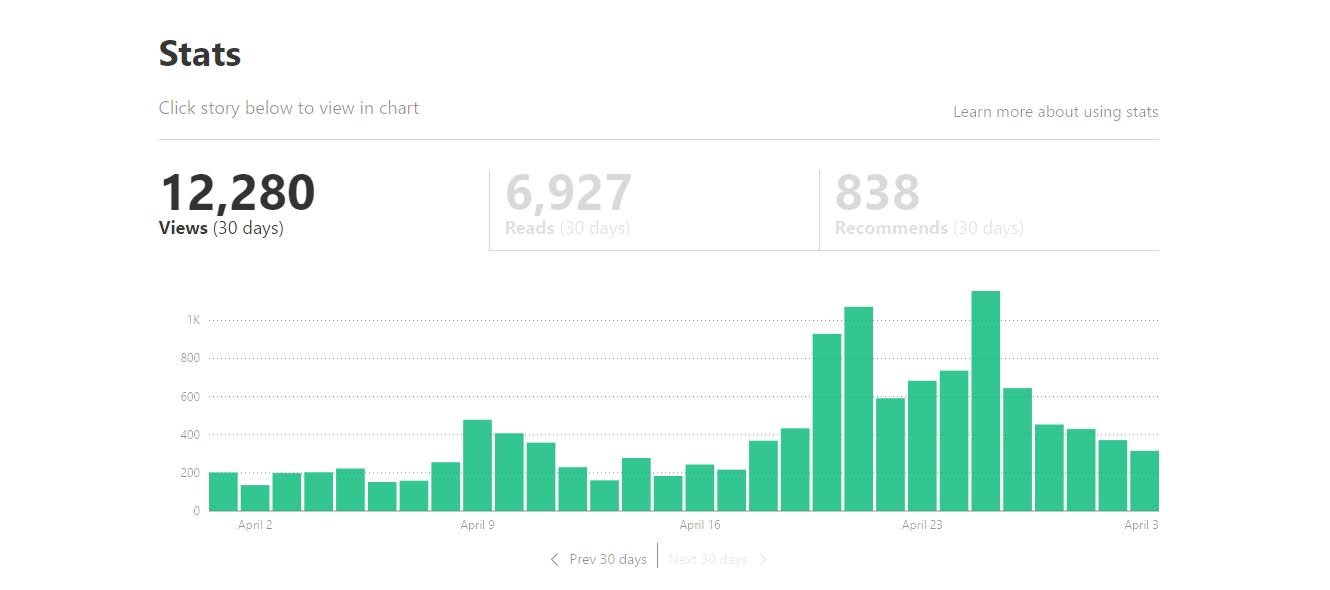
medium 12k views

The problem here is that they couldn’t continue to create high-quality content each and every day – and their readers noticed.

The key to getting attention through your content is finding the right balance between quality and quantity.

You also want to go beyond simple blog posts.

While blogging is a great way to bring traffic to your website, it doesn’t appeal to everyone.

Not everyone likes to read blog posts.

In fact, 53% of consumers said they’d like to see more videos in the future.
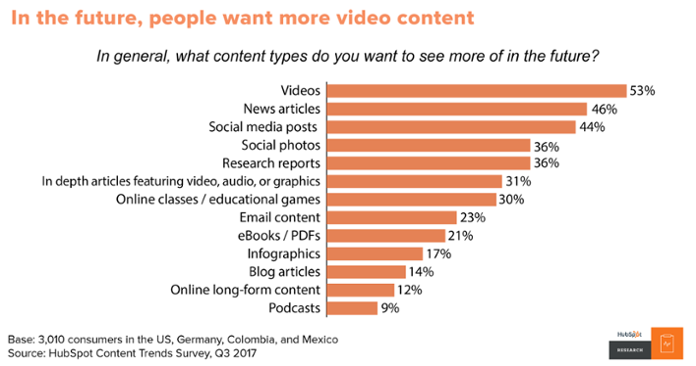
what type of content do people want

And with customers becoming more and more dependent on voice search and smart speakers, blogging isn’t always the most effective way to deliver content.

When you’re thinking about how often you should publish, you also want to consider what you’re publishing.

Videos can be a great way to grab attention, break down complex topics in a way that is easier for your audience to understand, or show off your products.

For example, Red Bull uses YouTube to show off the extreme sports, events, and competitions they sponsor.

With over seven million subscribers to their channel, Red Bull has one of the most popular YouTube pages out there.

Infographics are another way you can make your content more interesting for your audience, especially if you’re showing off large amounts of data or research.

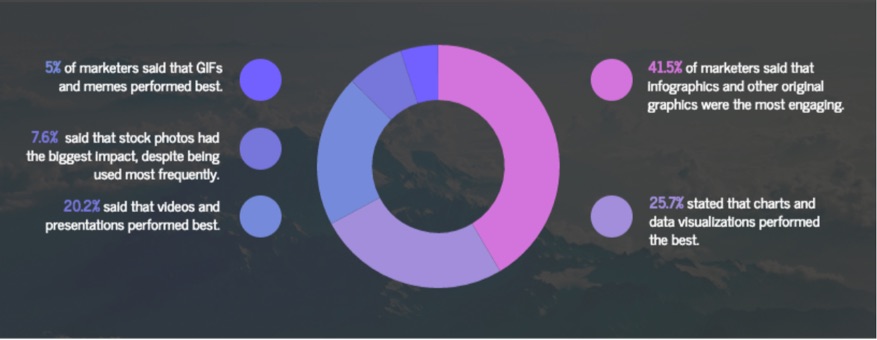
In fact, over 41% of marketers said that infographics were the most engaging forms of visual content for their audience.
visuals in content marketing

This ranked even higher than videos.

Infographics are insanely popular because they’re easy to skim and visual, making them ideal content for your always-busy customers and clients.

You can also expand your reach and get more attention to your content by producing podcasts.

Podcasts have been increasing in popularity over the past couple of years, with an estimated 67 million individuals listening to podcasts every month in 2017.

Repurposing written content into spoken can help you reach customers who don’t enjoy reading – expanding your audience to new individuals.

When trying to create different kinds of content, don’t be afraid to get creative.

However, you always want to think back to your target audience.

Focus on creating content that your audience will want to engage with.

3. You’re confusing content with sales pitches

Your content shouldn’t sell.

Sure, the whole purpose of marketing is to create interest in your business and drive sales.

But you can’t start out a relationship with a potential lead with a sales pitch.

Today’s customers don’t like being sold to.

That’s mainly because they don’t need to be sold to.

With the Internet at their fingertips, customers are more capable of discovering their options without ever needing to speak with a salesperson.

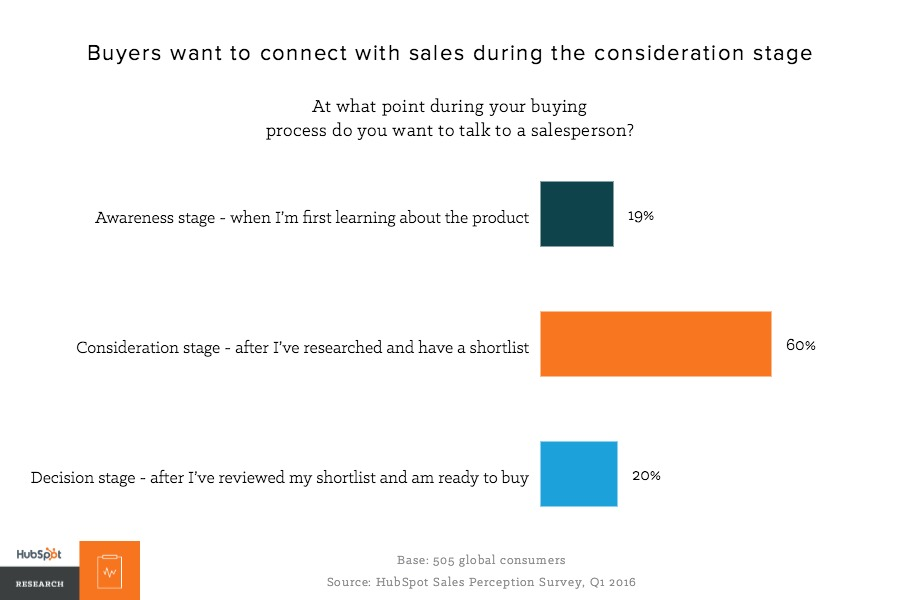
In fact, 60% of consumers won’t connect with a salesperson until they’ve already created a shortlist of potential purchases.
buyers want to connect with sales

By the time they’re ready to buy, they already know more or less what they’re looking for.

This means you need to use your content to educate them – before you ever have the opportunity to connect.

Your content should be specially formatted to meet the unique needs of your buyer during every stage of their journey.

Let’s break down what that journey looks like.

First, your lead needs to become aware of your brand.

This means you need to be entertaining, engaging, or interesting enough to stand out from the piles of information already on the web.

You can do this in the form of videos, fun blog posts, educational webinars, and engaging social posts.

Take a look at this Instagram post from GoPro.

instagram gopro

This high-quality image is attention-grabbing, causing followers to stop their scrolling and take notice.

However, it also shows off what the GoPro is capable of – increasing awareness about the brand and its products.

Next comes the consideration phase.

During consideration, your audience needs to better understand their problem, as well as their available solutions.

The content you might create for them could include product comparison videos or articles, case studies, or podcasts.

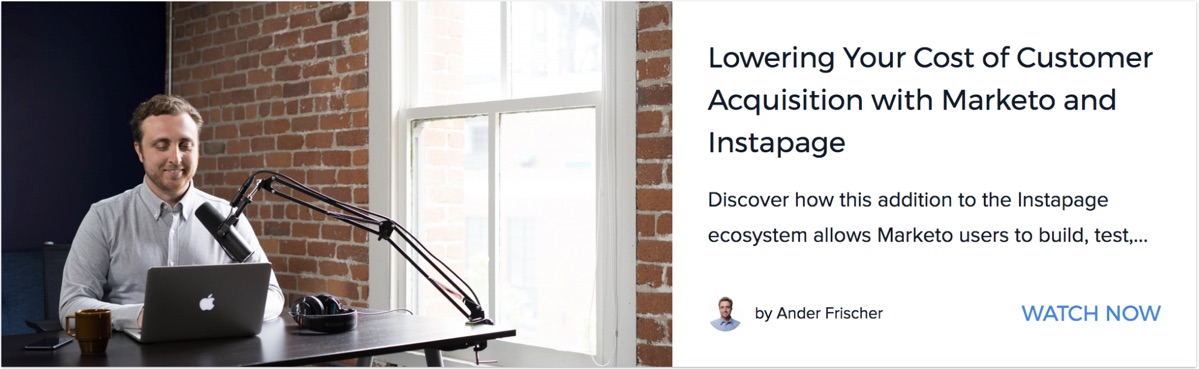
Here’s an example of a webinar from Instapage that would attract customers in the consideration phase.
instapage webinar

During this webinar, participants learn more about how Instapage and Marketo can help lower their cost of customer acquisition, helping them determine if it’s the right solution for them.

This then brings the lead to the next stage of the buyer’s journey – the decision phase.

At this time, your lead is ready to choose which product or service is right for them.

You can encourage their decision with testimonials, product reviews, and demonstration videos.

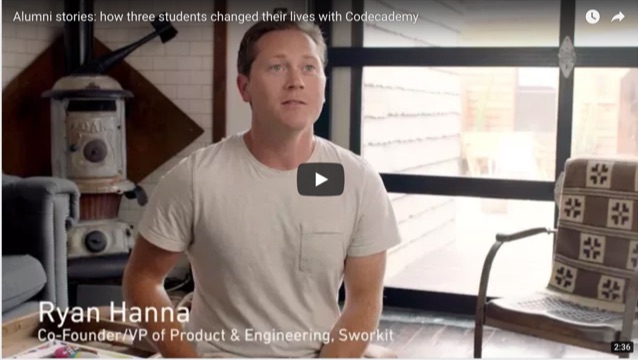
Codeacademy uses their Stories page to share how past participants have used their skills to change their lives or careers.
codecademy video testimonial

These stories function the same as testimonials, allowing potential customers on the fence about purchasing to see how the decision influenced other customers’ lives.

Raphael Paulin-Daigle of SplitBase.io tells ConversionXL, “A type of social proof that works over and over again is testimonials. Whether it’s in video or written form, they’ve helped increase the conversion rate of the clients’ landing pages in every case.”

If your customer decides to buy, they’ve finally reached the delight phase of the buyer’s journey.

Here, they’ve already purchased, but you want to use your content to encourage them to buy again.

You can do this with newsletters, training webinars, or customer satisfaction surveys.

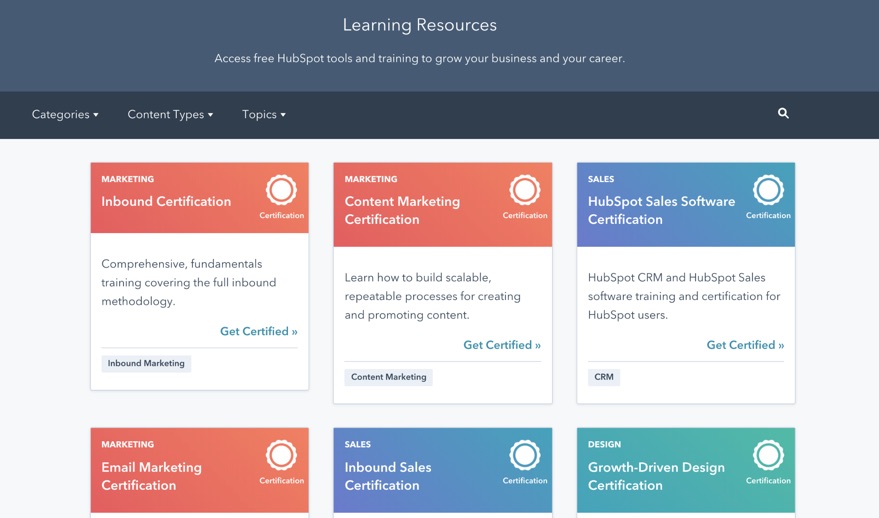
The Hubspot Academy is an example of content that reaches customers who have entered the delight phase of the buyer’s journey.
hubspot academy learning resources

By offering training and certifications, Hubspot stays in touch with customers while providing content that can improve their experience as a customer.

Notice how none of these content forms include a sales pitch.

Instead, during each step of the way, the focus is on the customer and helping them find the right solution to their problem.

When your audience feels like you’re helping them, they’ll be more inclined to engage with your content.

4. You don’t know your audience

When you create a piece of content, do you know who you ultimately want to engage with it?

You’re probably thinking “customers.”

Unfortunately, just trying to attract anyone with a credit card isn’t going to get you great results.

With the mass amounts of content and information on the Internet, customers can find content that speaks directly to them – no matter how niche that might be.

To get attention, you need to find your audience and create content just for them.

When you focus your content, you might be narrowing down your audience pool, but you’re making deeper connections.

This can help you see real growth from your content.

Let’s take a look at how Modernweb used a hyper-targeted content strategy to bring in 10,000 visitors in just three weeks.

They started with defining their “who.”

And they got specific.

They came to the conclusion that they would be writing for “technology executives inside of enterprise companies.”

While they had clients who owned startups and small businesses, they weren’t their ideal client. So, they weren’t an area of focus.

Next, they dove into understanding the day-to-day pain points that those individuals experience.

Finally, based on the audience and pain points they established, they created a content plan that addressed those needs.

In this case, Modernweb decided they’d focus on sharing stories from enterprise businesses who had recently switched from older to newer frameworks.

They identified their audience, understood what they were struggling with, then presented them with content that explained how similar individuals handled the same problem.

In just three weeks, their web traffic saw a major jump.

google analytics drop

Just from getting to know their audience, they were able to bring more unique visitors to their website and keep them engaged for an average of 9 minutes.

There are a few different ways you can begin to replicate Modernweb’s results.

First, create a buyer persona.

A buyer persona walks you through who your ideal client is.

Here’s an example from ClearVoice.

clearvoice female buyer persona

It breaks down exactly who they are, what problems they experience, and what kinds of solutions they might be looking for.

You can go deeper into your buyer persona to explain things like what they do each day, what kind of education level they have, or what they might do in their spare time.

The more detailed you can get with your buyer persona, the more targeted you can make your content.

If you have a wide range of products or services, you may also want to create multiple personas.

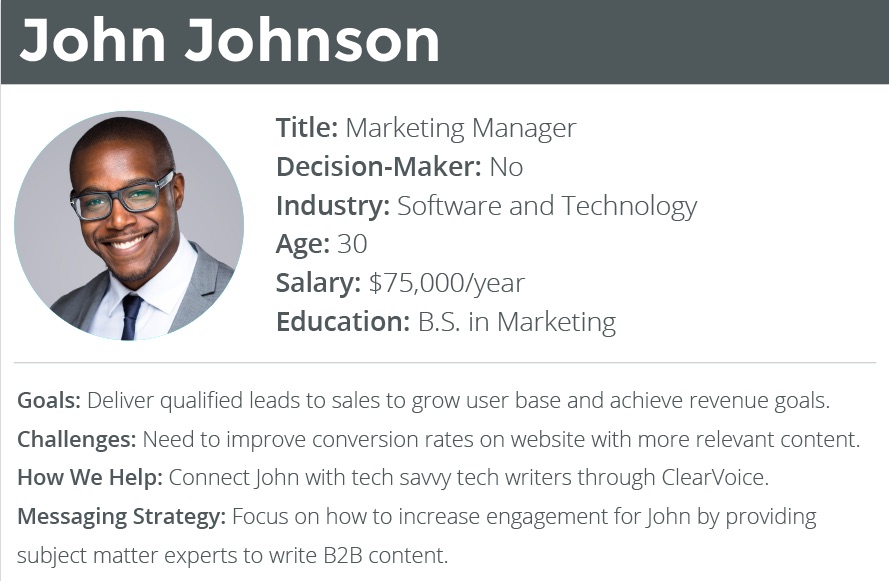
For example, here’s another example from ClearVoice.
clearvoice male buyer persona

While both John and Sandy have similar needs, they have different goals and challenges – meaning they’ll need to be targeted differently.

This can ensure that each of your audience members is well represented.

Next, pay attention to what they’re doing on social.

Monitoring your customer’s social activity can give you insights into the problems they’re facing, the solutions they may want, and what questions they may have.

You can then use this information to refine your content and guarantee you’re creating something they care about.

Check out the questions they’re asking on traditional platforms like Facebook or Twitter, but also dive into question sites or forums like Quora and Reddit.

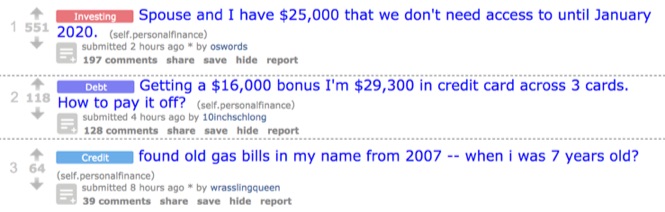
For example, if you’re a personal finance firm looking for content ideas, the Personal Finance Reddit page can be a goldmine.
personal finance reddit

Users are constantly jumping on to ask questions about paying off debt, how to properly invest, or get advice on what to do in credit scams.

Knowing the real-life struggles your audience is facing can help you adjust and refine your content strategy to truly fit their needs.

Both of these pages can give you a great jumping off point for creating new content.

Finally, participate in conversations with your audience.

Get involved in Twitter Chats or Facebook Groups where your audience is hanging out.

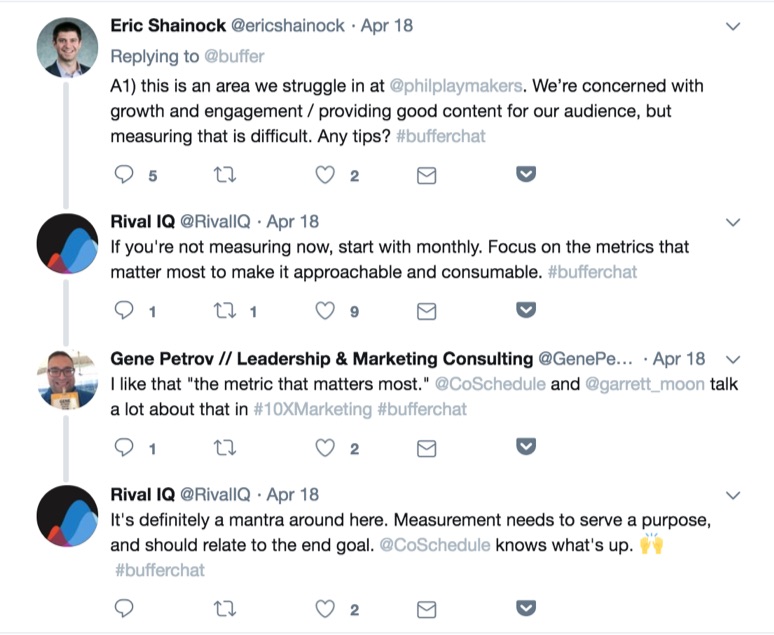
Check out how RivalIQ gets involved in a conversation with a participant during the #BufferChat.
bufferchat with rival IQ on twitter

Not only does this allow them to make a great impression, but it also gives them some insight into what potential customers may be struggling with.

As you become familiar with the conversations they’re engaging with, you can refine your messaging and topics to better suit their needs and preferences.

5. Your voice isn’t genuine

Customers want to purchase from companies they believe they can trust.

In fact, the top quality that customers look for in a brand is honesty, followed by friendliness and helpfulness.
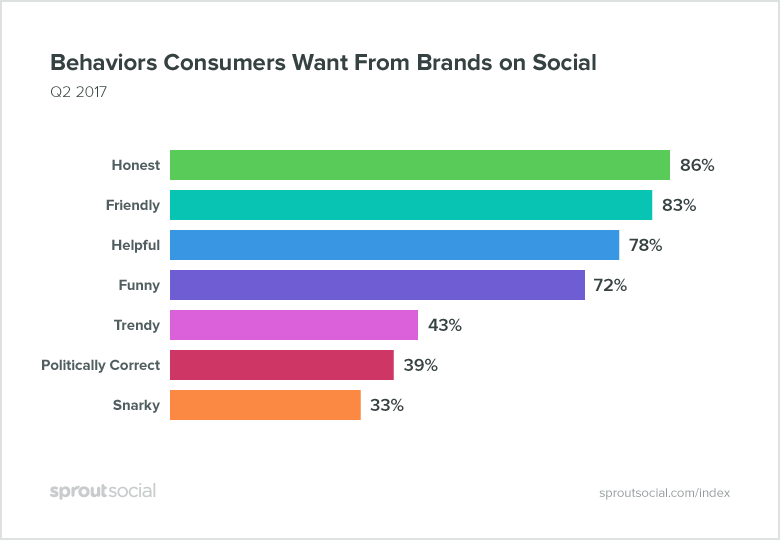
behaviors consumers want from brands

However, if it seems like you’re just putting on a persona for sales, they’re going to be hesitant to connect.

When creating your brand voice, it needs to connect who your brand is with who your audience thinks your brand should be.

Let’s consider this graph for a second.

Snarkiness is the last thing that customers what when it comes to brands on social media.

However, when we look at brands like Wendy’s and MoonPie, their attitude gets them hundreds of thousands of engagements.

So, what’s going on here?

Both Wendy’s and MoonPie have made it their brand persona to be snarky, witty, and sarcastic on social.

It’s who they are – and that’s why it works.

They’re not pretending to have an attitude just for attention.

It’s a unique indicator of their content, allowing them to create a reputation that makes customers want to connect.

Check out this quote from Juntae Delane, Founder of Digital Branding Institute.
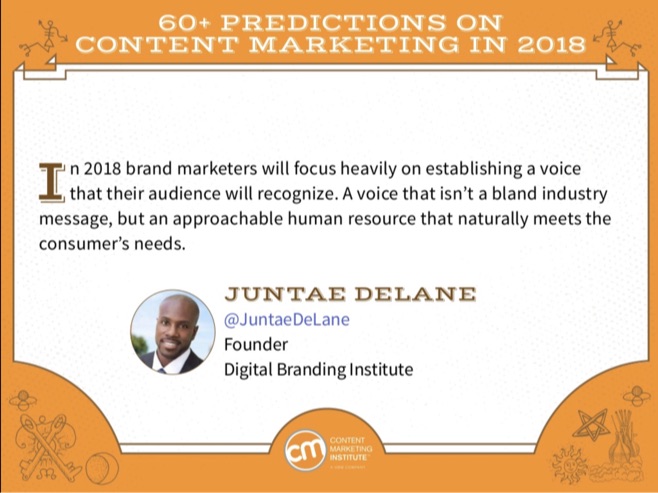
content marketing predictions for 2018

According to Juntae, a brand’s voice needs to go beyond simple industry jargon and bland business tones.

Instead, it needs to match with the customer’s needs and provide a human element to the brand.

You can build your brand voice off the buyer persona you’ve created.

Based on your buyer persona, get familiar with the kind of language, tone, or colloquialisms your audience may be using.

Check out how they speak on their own social media platforms.

Then, take a look at the competitors or other brands they’re engaging with.

Once you’re familiar with the way they communicate, create a storyboard for your voice.

Think of your brand as a unique individual.

Outline what your brand likes, what they don’t like, how they perceive themselves, and how they want to be perceived by others.

You’ll also want to dig deeper to consider larger ideas that might not have any direct influence on your brand.

Today’s customers are expecting brands to be more than just a business.

For example, 65% of consumers believe it’s important for brands to take a stand on social or political issues.
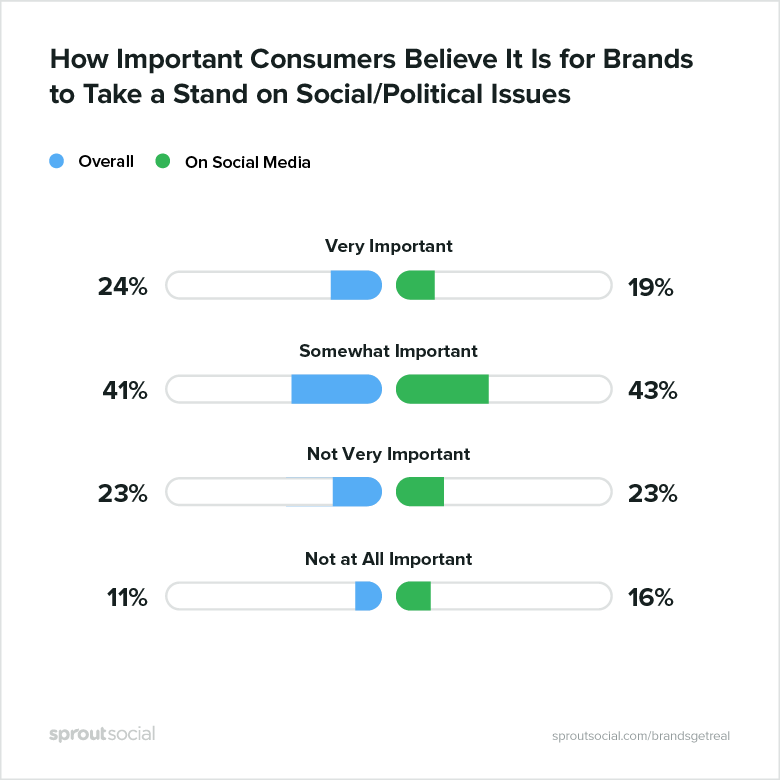
how important is it for brands to take a stand on social and political issues

Take a look at the conversation created around Fox News anchor Laura Ingraham criticized Parkland school shooting survivor and gun control advocate, David Hogg, for getting rejected from four colleges.

David responded by calling out all of Ingraham’s advertisers, asking them to pull their support of the show.
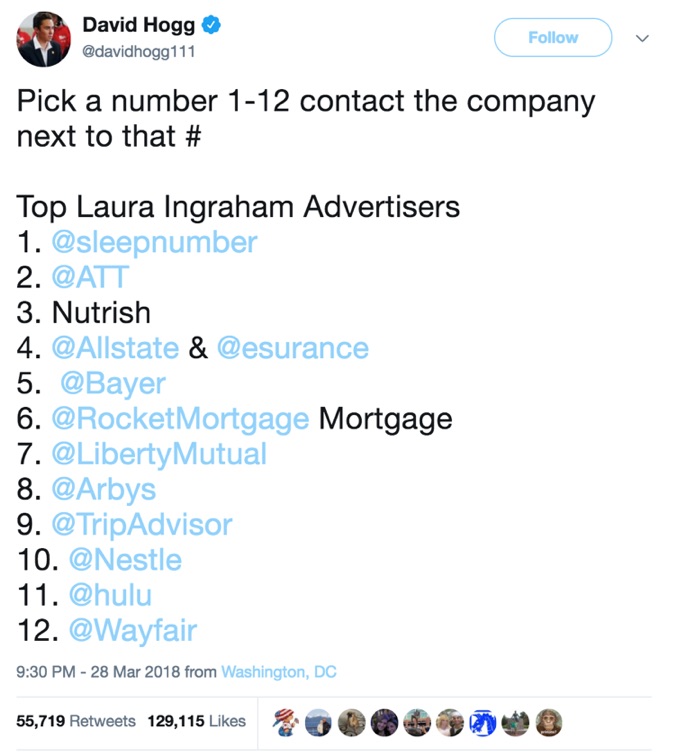
david hogg pressuring advertisers through Twitter

Within a few days, companies like Hulu, Bayer, and Nutrish had announced they’d be pulling the ads from Ingraham’s program.

After a few weeks, the program had lost 24 advertisers.

However, not all advertisers chose to separate.

Mike Lindell, founder of the MyPillow, announced he would be leaving his advertisements on the program.
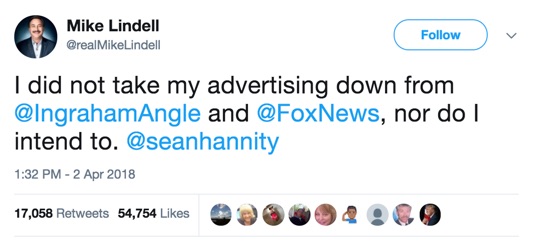
By becoming a part of important conversations and debates, brands can refine their voice and make their opinions and beliefs more well known.

While it’s impossible to prepare for every kind of hurdle or backlash your brand may experience, knowing where your brand falls in these situations can help you create consistent messaging through your content.

6. You’re not promoting

Remember when Beyonce released a surprise album without any marketing?

In three days, she sold almost 830,000 albums.

It was impressive.

However, if you’re trying to use this tactic to promote your content, you’re in for a rude awakening.

Unfortunately, you’re not Beyonce.

And that means you need to promote.

Proper content promotion is really the key to getting attention to your content.

If you’re simply posting links to your latest blog post on your Twitter account, you’re probably going to get ignored.

Take a look at this Tweet from user Vic Maine.
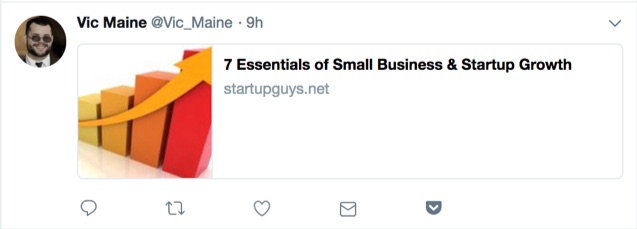
vic maine low quality tweet

It’s just a link, featuring no context, hashtags, or other interesting information that might entice the reader to engage.

So, it’s not really surprising to see it hasn’t started any conversations or gotten any traction.

However, you can refine your promotion strategy to include email marketing, social, forums, and influencer marketing to improve your results.

First, let’s take a look at social.

Companies have been promoting their content on social for years.

However, the way you should promote and where you should promote is always changing.

Just one shift to the network’s algorithm or design (or even a negative post from an influencer) and your entire promotion strategy might be turned upside down.

Take a look at Facebook, for example.

After changing their algorithm, many brands reported a drop in organic reach.

However, you can work around this algorithm shift by either paying to promote your content or creating content that your audience wants to engage with.

Check out this breakdown Buffer created of important signals that can influence your ranking on Facebook.
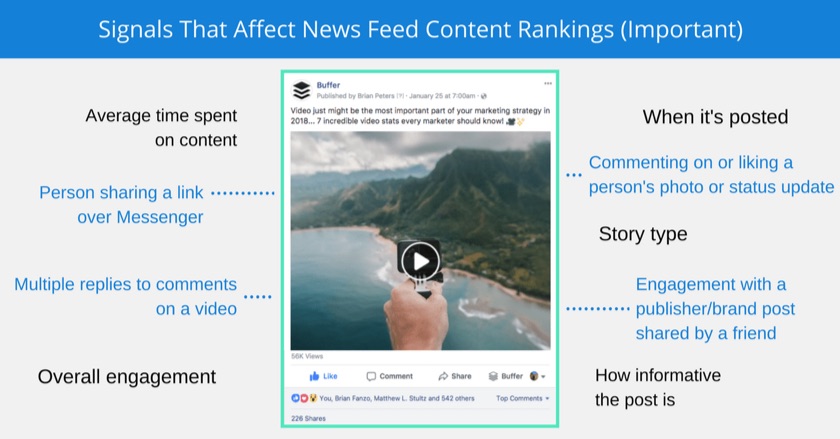
ranking signals in news feed rankings

As you can see, some of the most important factors of what gets ranked depends on how users are interacting with the post.

This means you want to focus more on creating content that individuals want to engage with, rather than strictly shock-value content.

You should also make your content easy for your readers or viewers to share your content on their own.

Within blog posts, including “Click to Tweet” bars or share buttons can help encourage visitors to share the content with their friends or family – helping to improve your reach.

Content Marketing Institute frequently uses Click to Tweet bars to make it easier for their readers to share their content.
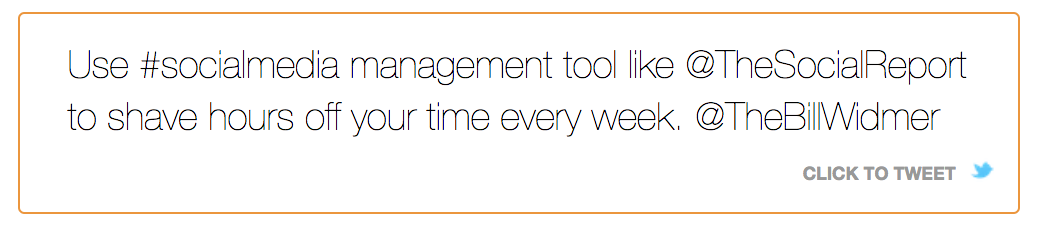
content marketing institute click to tweet

You can also use more targeted marketing approaches to help reach your audience, such as email marketing.

When you properly segment your email lists, you can share your content with individuals you already know are interested in what you’re sharing.

Take a look at the results MailChimp found for campaigns segmented by interest groups.
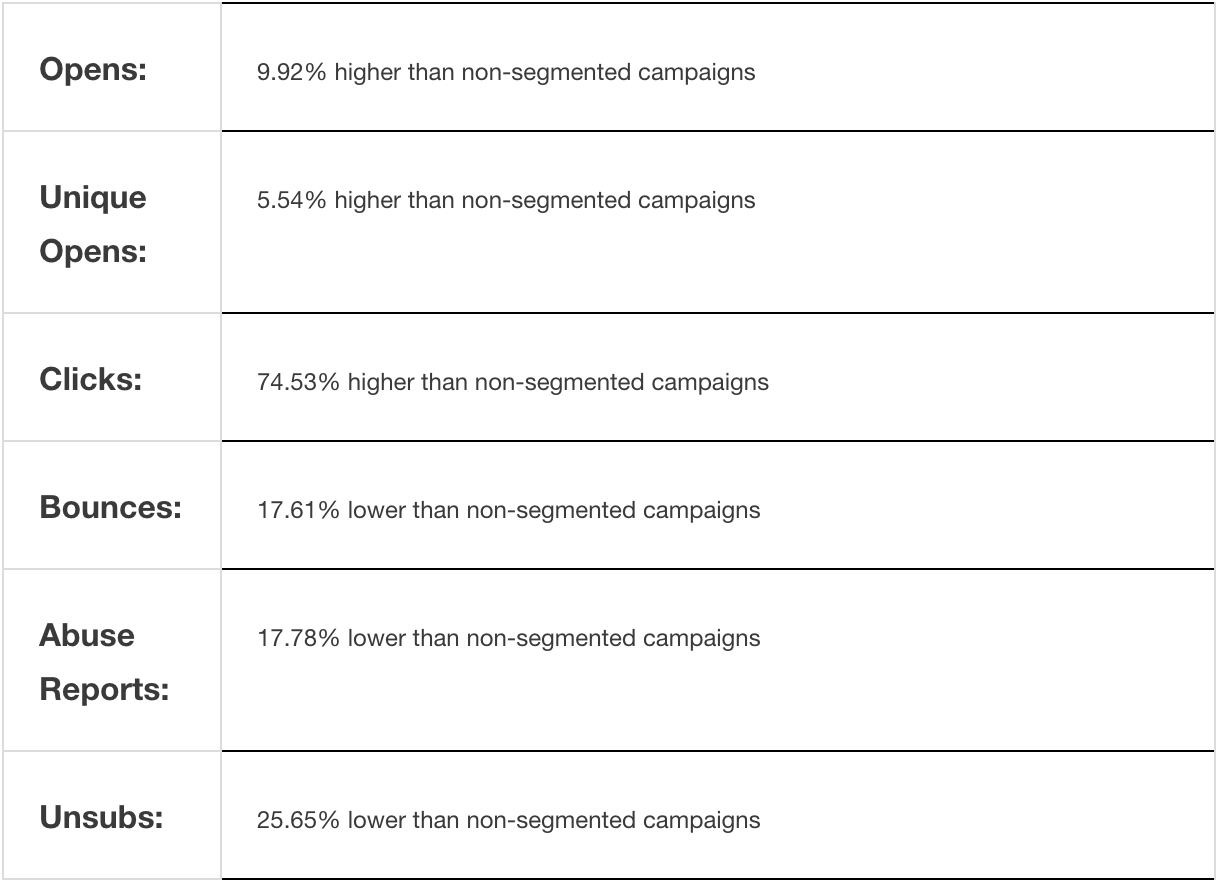
mailchimp campaigns segmented by interest groups

By sending specific content to your audience members based on their interests, you can dramatically improve your campaign results.

7. Your content isn’t properly optimized

Promoting your content is just one side of the coin.

To truly bring attention to what you produce, you want your audience to be able to find what you’re creating.

This means it needs to be properly optimized.

Each piece of content should comply with your greater SEO strategy.

This means going beyond just creating content that your audience wants to read or engage with.

Keywords should be factored into each piece of content you create.

By finding words or phrases that your audience is actually searching online, you can increase your chances of them finding you.

The Keyword Planner from AdWords is one way you can find new keyword opportunities.
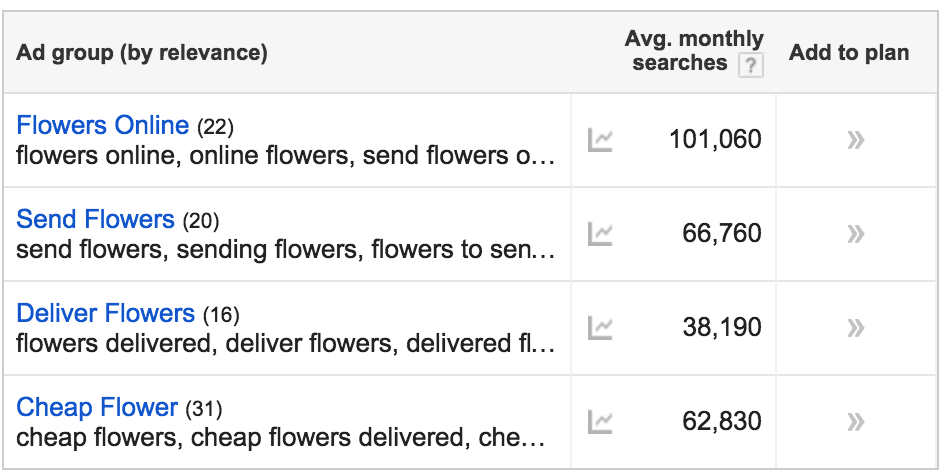
flowers online keyword planner

You want to find keywords that are high in average monthly searches but low in competition.

Don’t simply guess at what you think your audience wants.

You also want to make sure your content is properly formatted.

Your titles and heading should be strong and capable of standing on their own.

According to CopyBlogger, 8 in 10 individuals will read a headline – but only 2 in 10 will read the rest.

This means you need to create headlines that your audience can’t resist.

The CoSchedule Headline Analyzer is one tool you can use to improve your headlines.
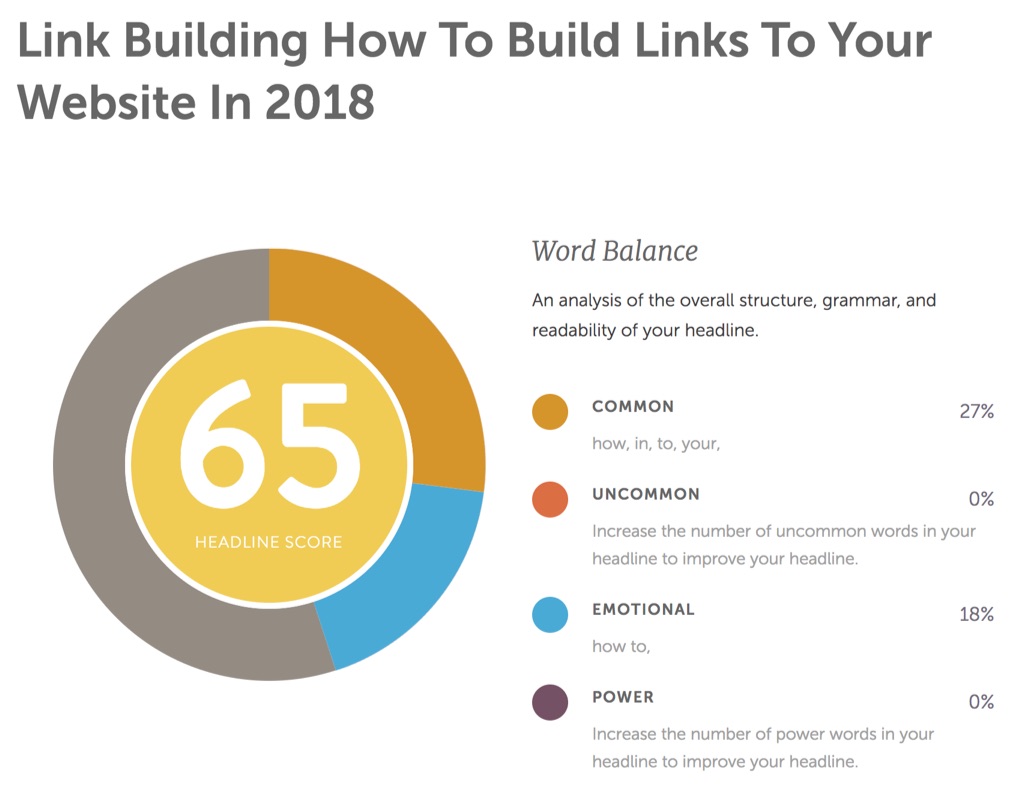
word balance in headlines

The tool analyzes your word balance to give you an overall score out of 100.

It also provides you with insights on length, sentiment, and even guesses which keywords it believes you’re targeting.
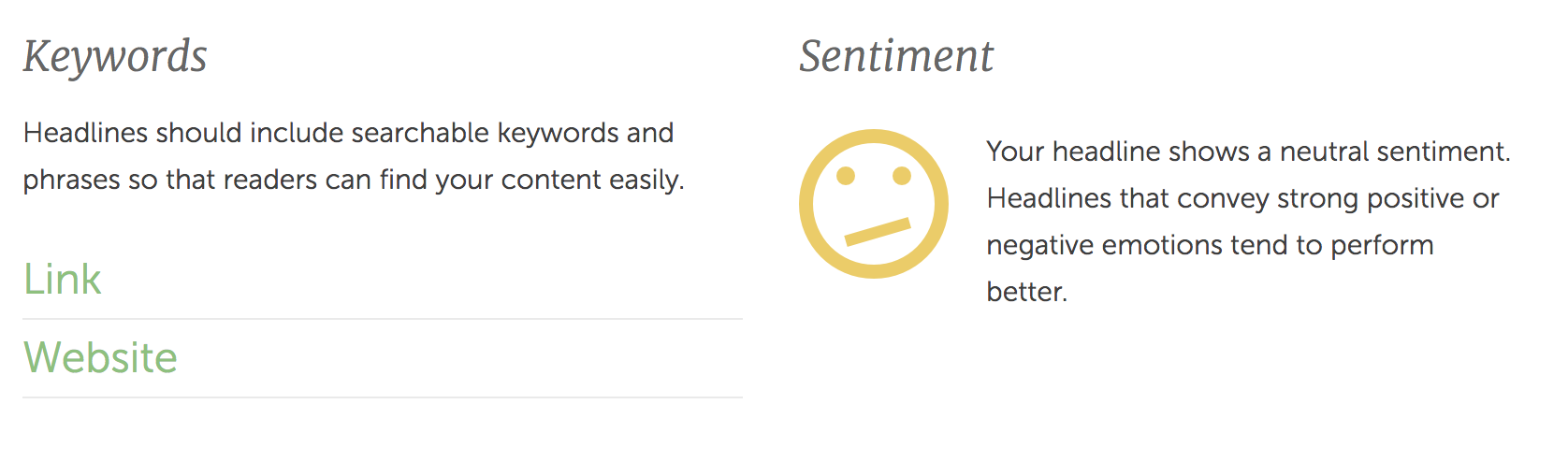
headline keywords and sentiment

This can help you test the strength of your headlines before you post, saving you trouble and guaranteeing higher results.

But blog content isn’t the only thing you need to optimize.

You also want to make sure your videos, infographics, and images are optimized appropriately.

To optimize your videos on YouTube, start with an optimized title that describes the video and includes the keyword you’re trying to rank for.

This isn’t too much different than writing blog titles.

However, you also want to tag your videos appropriately and write a full description.

Your video description lets the YouTube algorithm know what your video is about.

Check out this description from a DottoTech video.
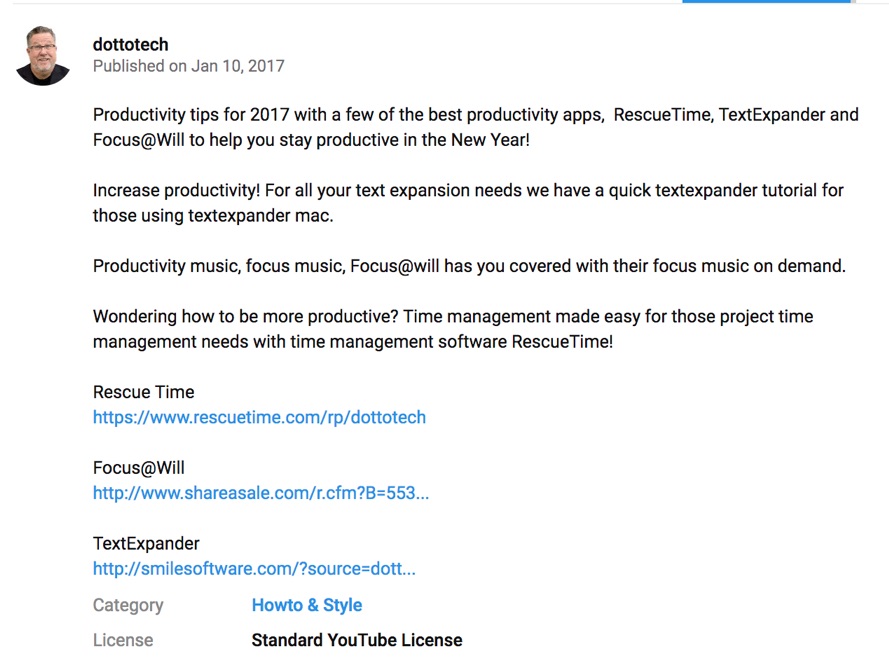
dottotech youtube video description

He provides a clear overview of what will be featured in the video, as well as some links to the apps he’s going to talk about.

This can help improve his connection to those pages and gives him the opportunity to further target his keywords.

Images are another area you’ll want to ensure are properly optimized.

First, make sure you’re using high-quality images that are the appropriate size for where they’re being placed.

This can help improve your page load time to keep visitors happy.

You can use a compressor tool to change the size of your image without hurting the quality.

You’ll also want to place the keyword you’re trying to target in the file name.

Because Google can’t actually see what your image is, it’s your responsibility to tell them.

Use captions, alt text, and title text to give Google a better understanding of the image you’re sharing.

Conclusion

In today’s digital age, you can’t afford to create content that is easily ignored.

However, it takes time to craft messaging that your audience will want to engage with.

Keep these seven tips in mind the next time you create content.

What tips or tricks have you found that improve your content-creation process?

About the Author: Neil Patel is the cofounder of Neil Patel Digital.

Reverse Phone - People Search - Email Search - Public Records - Criminal Records. Best Data, Conversions, And Customer Suppor

Wednesday, May 2, 2018

How to Repurpose Content (and Why it Matters)

Something every woman should know - WHY MEN LIE!

There’s no need to reinvent the wheel.

Ever heard that before? It’s excellent advice for virtually every job, task, industry, and endeavor. If you have something that works, use it.

Build off it. Adapt it. There’s no need to start from nothing

And when it comes to your content marketing, it’ll not only save you time, but it can deliver big, big results.

How so? By repurposing content you’ve already created.

“Repurposing your content opens the doors to reaching more people and breathes life back into old posts that you know are well written and highly informative.” ~Elna Cain, Professional B2B Writer

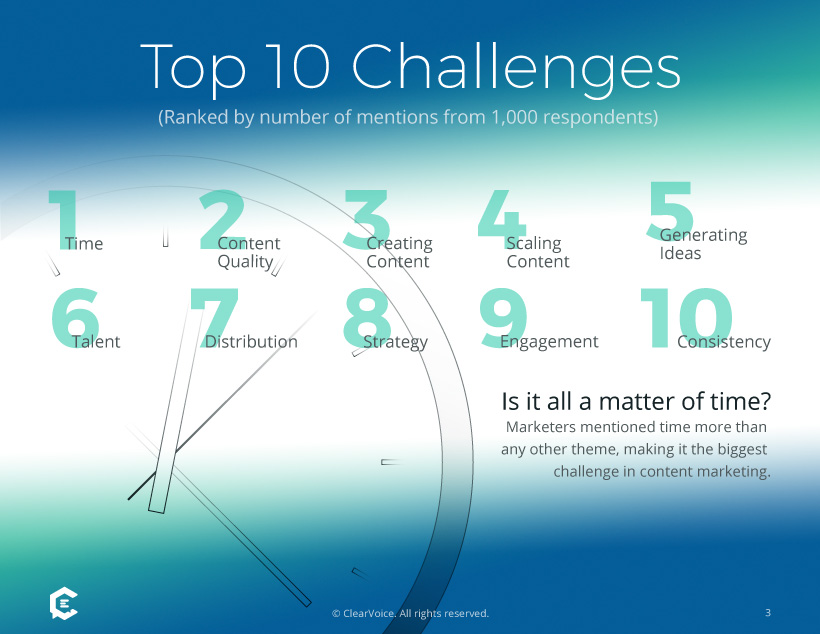
29% of top marketers repurpose their best content, while 27% listed producing enough quality content as their biggest challenge in a separate survey.

top content challenges for content marketers

Overall, not having enough time, the quality of their content, creating that content, scaling content creation, and generating ideas were the top five most mentioned challenges facing the modern marketer.

The benefits of repurposing content? Those top five challenges are alleviated and made easier.

You could brainstorm new ideas, conduct research, draft, revise, polish, a/b test headlines and blurbs, publish, and promote a new blog post every few days…

Or you could take an existing asset that’s already a winner, repurpose it, and promote, promote, promote.

Which one sounds like the better use of your time?

What is Repurposing Content?

It’s exactly what it sounds like.

Repurposing content simply means taking an existing piece of content and using it in a new way for a new audience.

Blog series to ebook, for example. Or infographic to video.

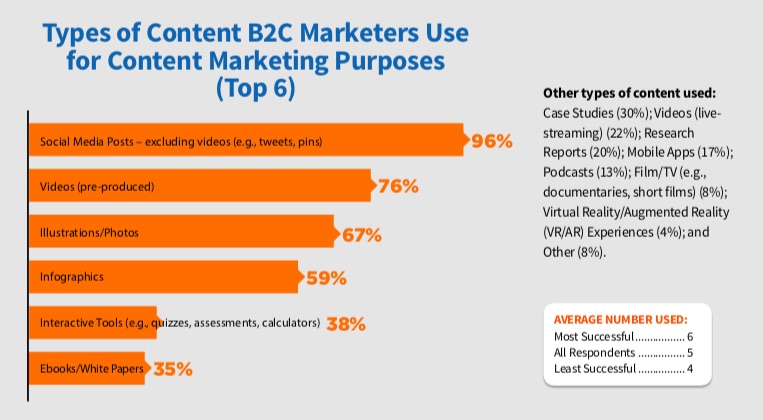
There’s no shortage of transformations you could make. Marketers use a wide variety of channels, types, and formats for their content.

types of content used by b2c marketers

Videos, illustrations, infographics, ebooks, white papers, webinars, case studies, podcasts, charts, graphs, blog posts, quizzes, slide decks, reports, and on and on.

In fact, releasing quality content as only one type is really doing it and your audience a disservice.

Why Should Your Website Repurpose Content?

To begin with, not everyone likes blogs. Or videos. Or white papers. Or infographics.

If you spend hours, days, or weeks creating something spectacular, and you release it to the world as “just” a blog, many people will never give it a second look.

Content marketing is about getting as many eyes on it as possible.

Eyes on it means traffic, traffic means shares and interest, shares mean more eyes and greater awareness which generates still more eyes on it, which means more prospects and potential for conversion, and round and round it goes.

“Content marketing’s purpose is to attract and retain customers by consistently creating and curating relevant and valuable content with the intention of changing or enhancing consumer behavior. It is an ongoing process that is best integrated into your overall marketing strategy, and it focuses on owning media, not renting it.” ~Content Marketing Institute

Attract and retain customers.

Let me ask you this: are you only targeting blog readers? How about only those that watch videos online? Do you only want to keep those existing customers that enjoy infographics? Of course not. You would never intentionally limit yourself, your brand, or your product that way.

But without repurposing your content, that’s essentially what you’re doing. You’re not providing for them in the ways they want and appreciate.

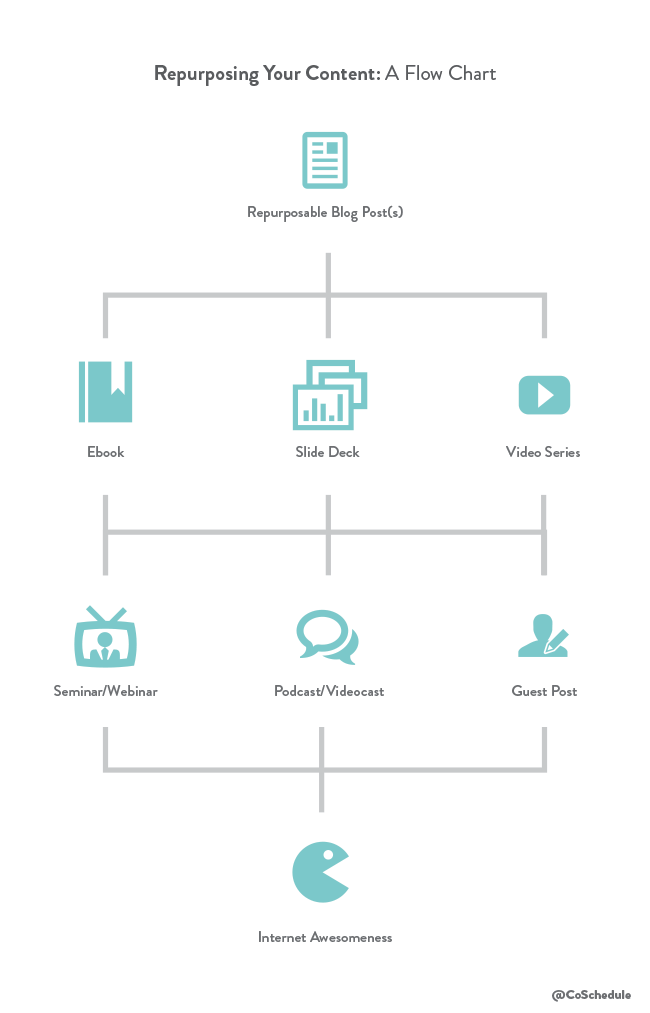
repurposing content flow chat

Repurpose your best stuff, and it reaches more of your target audience in the places and ways they want to be reached.

Benefits of Repurposing Content

In addition to reaching a wider audience in the types and formats they want, the benefits of repurposing content include:

  • Better chance to be seen. We spend a lot of time online: an average of 40 minutes/day on Youtube, 35 minutes on Facebook, and 15 minutes on Instagram. It adds up to 5 years and 4 months over our lives. That’s nothing to sneeze at, but it also means there’s a greater probability of someone missing that tweet about your new blog post than of seeing it. Social media moves too fast, and no one is online all the time. Want your content to be seen? You’ve got to repost and repurpose. The rule of seven tells us that the average consumer needs to see your message seven times before they buy into it…or you.
  • The life expectancy of a social media post is relatively short: a typical tweet has a half-life of 24 minutes, a Facebook post reaches 75% of its maximum impressions in 2 hours and 30 minutes, and blog posts by top brands receive 50% of their comments in the first 6 hours. The takeaway? Repost, reschedule, and repurpose.
  • Give your search engine optimization efforts a boost. A well written blog post will have several targeted keywords. Repurpose that content as an infographic or podcast, and you’ve increased the opportunities you have to rank for those keywords. A better rank – or multiple rankings – means a better chance to divert more of that search volume traffic to your digital doorstep. You’ve already done the keyword research, so maximize your possibility of succeeding with it.
  • Save time for promotion, which is the lifeblood of content marketing. The less time you spend on brainstorming, researching, and creating content, the better. The majority of your time and effort should be spent on promoting it, not making it.
  • Build your authority and reputation. The more people see your name attached to content on a particular topic or industry, the more your online reputation grows. You need to be seen as an expert. You want to be considered the go-to guy or gal. Authority is one of the six principles of persuasion as outlined by Robert Cialdini. Persuade, then convert.
  • Increase your return-on-investment. Quality content takes time and money to create. Repurposing blogs, repurposing video content, and content recycling in general lets you squeeze extra value out of money you’ve already spent. Get more with no additional cost. That’s a business strategy everyone can get behind. That $500 blog post can be repurposed for next to nothing, giving you more bang for your original buck.
  • Diversify your content catalog. No one wants the same thing for supper every night.
  • Generate more opportunities for quality backlinks. People sharing your content creates backlinks to your site, and they’re a crucial and beneficial ranking factor.

It takes a great deal of resources – time, energy, and money – to produce a valuable, useful piece of high quality content.

Using it once is a waste. You wouldn’t buy a new laptop and log on just once, or use it just for emailing, right?

So why do that with your content? The mantra for content marketing in 2018 and beyond should be “repurpose, promote, repeat”.

4 Repurposing Content Examples For SaaS Business

By now, you should be convinced of the benefits of repurposing and are probably ready to see some content repurposing examples.

The proof, as they say, is in the pudding.

Does it really work? What exactly can be repurposed? Let’s take a closer look.

The No New Content Challenge

Buffer is one of the major players in the content curation and scheduling game.

Many of you likely use its social media management platform in your content marketing.

The Buffer Blog consistently produces high quality and useful content on everything from social and digital marketing to productivity and the customer experience.

For one month in 2015, they wanted to see what would happen if they repurposed their existing content rather than created new stuff.

With a blog that regularly saw 600,000-700,000 monthly visitors, the stakes were high.

Instead of writing new posts, they created new email campaigns and ebooks using old blog posts, updated outdated posts, created SlideShares and videos from blog posts, and republished to Medium.

The result?

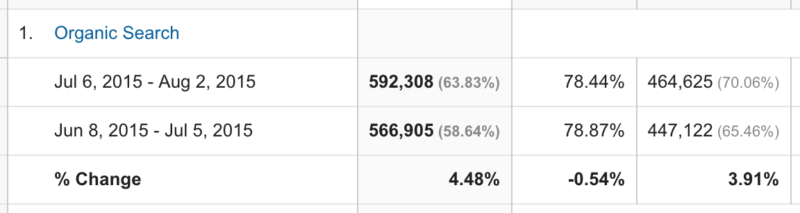
While overall traffic dipped slightly, their organic search traffic was up by over 4%, the resulting SlideShares produced nearly 200,000 views, an ebook on social media tips curated from old posts brought in 2397 signups and downloads, and an email drip campaign called “The 7 Day Social Media 101” and a 25-day video course nabbed 17817 and 18185 (in the first 6 days alone) signups, respectively.

buffer repurposed content experiment

And all with no new content for 30 days. So, does repurposing content work? (hint: yes).

Matthew Woodward

SEO and affiliate marketing professional Matthew Woodward decided to repurpose and republish a couple of blog posts on LinkedIn Pulse. With minimal tweaking, he published with a link to a new landing page for an existing lead magnet.

The experiment garnered 332 new subscribers and a conversion rate of 76.15%.

Convince & Convert

Jay Baer of Convince & Convert creates a lot of content, including 3-minute informational videos.

In order to reach a bigger audience, he and his team began repurposing that video content as blog posts on the C&C website, LinkedIn Pulse, and Medium, and as podcasts (distributed via iTunes), effectively covering the text, video, and audio crowds.

Convince & Convert has been crowned the #1 content marketing blog in the world by CMI, attracting hundreds of thousands of potential prospects for their consulting services and marketing tools.

Moz

It you want to learn about all things SEO, you need look no further than Moz.

Their blog is chock-full of posts on everything from keyword research to link-building to audits and everything in-between.

Once a week since 2007, they’ve repurposed their best blog content as an engaging and informative video series called Whiteboard Friday.

It’s legendary in the industry. Iconic. And its fans are legion.

That kind of loyalty, advocacy, and brand recognition is priceless, bringing in a steady stream of referred traffic and leads.

A mind-boggling 11% of the top SaaS companies in the world do not blog.

That’s shocking at any time, but in 2018 that’s simply insane.

A blog is the foundation of any content marketing plan.

And a blog is the content bank from which you can pull and repurpose from now until the cows come home.

Blog. Promote. Repurpose. Promote. Succeed.

How to Repurpose Content in 2018

By this point, you may be thinking “Okay, okay, I get it. Repurposing content is extremely beneficial and efficient.” And you’d be right.

But, you’re probably also thinking “How do I do it?” It’s one thing to know why, but something else entirely to know how.

It’s easier than you might be expecting.

Identify the Posts Worthy of Republishing

If you’ve got a sizeable content catalog, deciding which ones deserve your repurpose attention is step one.

Head on over to your analytics dashboard and check to see what posts have been your best performers in the past month, past year, and possibly even past 4-5 years.

Look for those posts with the highest pageviews and/or average time on page.

Use a tool like BuzzSumo to find your most shared pieces.

These are the pieces resonating most with your audience and visitors.

This is the content most likely to benefit from a little repurposing magic.

For each asset, consider how you might be able to transform it.

Blog to video, video to transcript, podcast to infographic, series to ebook, and so on.

While you’re at it, be on the lookout for content that is either a) outdated, or b) a topic on which you have greater knowledge now than you did when you wrote it.

These can be updated and expanded with little effort, allowing you to promote the new and improved version.

“Content repurposing doesn’t just mean that you reuse an old piece of content again and again. True repurposing requires that we alter it to make it fresh and appealing to a new audience.” ~Garrett Moon, CEO and Co-founder of CoSchedule

Repurposing content takes little effort, not zero effort.

What themes are still relevant? What topics are still popular?

On what subjects do you have more to say? Find content that fits in to those categories, and you’ve got yourself a winner.

Turn Old Blog Posts into Fresh and Complete Guides

This is perhaps the easiest repurposing you can do, but don’t let that fool you into thinking it’s not worthwhile.

The world moves pretty fast.

Some industries move even faster.

Posts you wrote last year – or even several months ago – can already be outdated.

Sometimes the just need a few tweaks.

At other times, they might need a partial or complete rewrite. Either way, you end up with something “new” to promote on your channels.

Even better, take several blog posts that share a broad subject and combine them into one complete guide.

A post about gaining Instagram followers, using that platform for business, how to write an Instagram bio, and best practices for increasing engagement can join together to create a powerful “Complete Guide to Instagram for Business”.

The “complete” or “ultimate” or “definitive” guide-type posts will always be popular. Harness that with minimal effort.

Create White Papers and Infographics

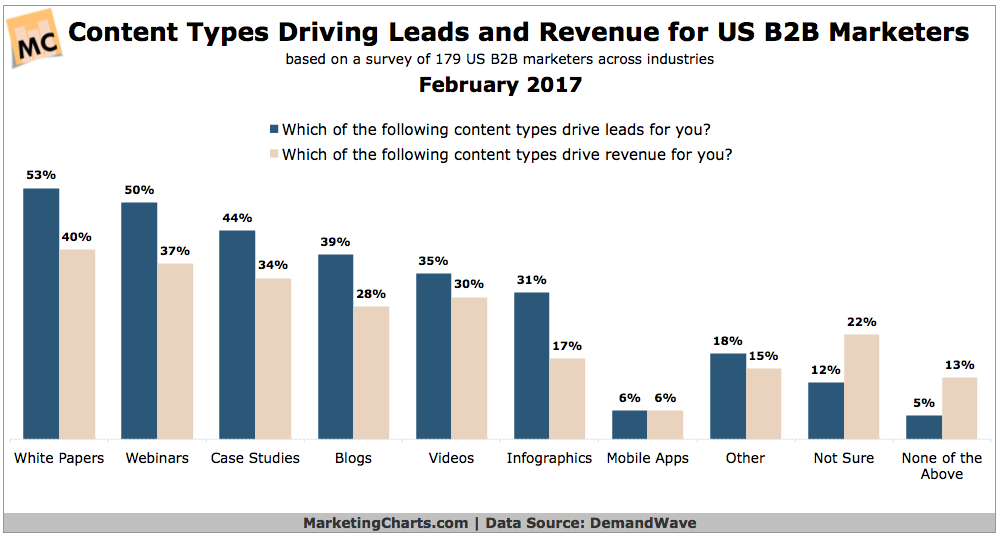
What type of content do you think drives lead generation? You might be surprised to learn its white papers.

types of content that drive leads and revenue

White papers are authoritative.

They cover a particular topic, presenting hard data and research to ultimately argue for a specific solution to a specific problem. They inform and persuade based on facts and evidence.

Done right, white papers build trust, increase your authority, and generate credibility for you and your brand.

They are research, data, chart, and graph heavy. Writing a white paper can be a time-consuming task.

But the don’t have to be. Your blog posts are full of data, graphics, and research already, right? Use that.

Combine several posts on the same basic subject, and you should have enough raw material to pull it together into a high quality white paper in half the time it would take to write one from scratch.

Use a template and save even more time. In the B2B sphere, they’re an absolute must.

And then we have infographics. Popular, powerful, and persuasive, a good infographic can disseminate information like few other types can. Consider:

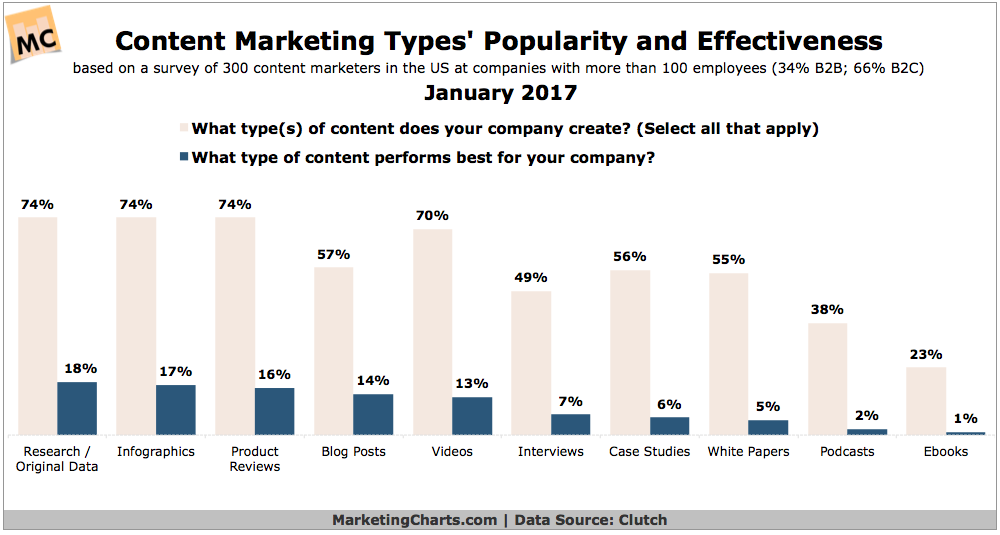
We are hardwired to understand and enjoy visuals, and infographics are very popular with both marketers and consumers alike.

popularity and effectiveness of different types of content

What’s more, creating infographics from existing content assets is quick and easy.

Services like Visually can do it for you, or tools like Infogram, Easelly, and Canva allow you to do it yourself.

The data collection and research is the “hard” part…and that’s already done and ready to use.

Turn Posts into a Webinar

Few content types are as engaging as a webinar or live stream.

They allow you to share your expertise, build credibility, and connect, communicate, and engage with your customers and leads in real-time.

The best webinars focus on one specific topic that you understand exceedingly well and can dig deep on. They have a spectacular slide deck that supports and complements the “script” you’ve written beforehand.

“There’s a lot of logistical things to think about, so even if you think you know what you want to say, you’ll be surprised at how quickly you forget once you get into presentation mode. Create a list of the questions as they come in so you can keep them organized. Lastly, relax! The attendees are there to listen and learn, not judge.” ~Chris McHale, Nurture Marketing Specialist at WordStream

Your most popular posts are prime candidates for the webinar treatment. Identify them, use them to create your slide deck and script, and promote your upcoming webinar everywhere you can.

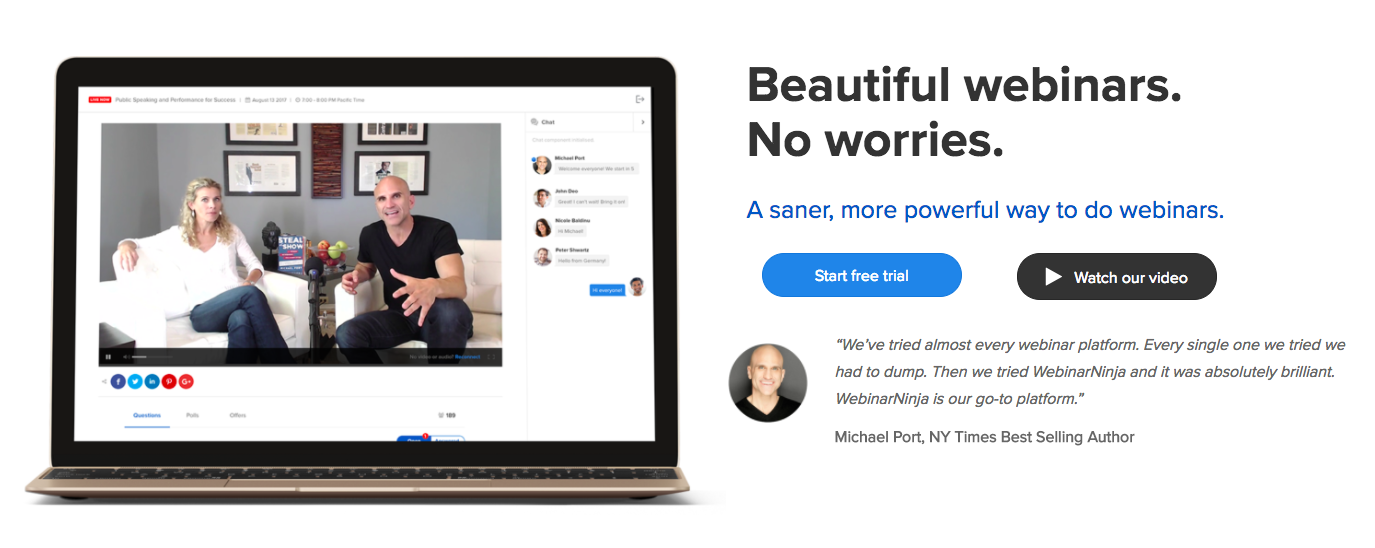
Service providers like WebinarNinja and GoToWebcast can help with the logistics and host hundreds if not thousands of attendees.

And once your webinar is finished, don’t forget to upload your slide deck to SlideShare, and post the recorded video to your blog. That’s 3-for-1. That’s repurposing like a boss.

webinars types of content

Create Videos

Think about how much video you consume on an average day.

A lot, right?

We love video. We seek it out. It rules the online roost:

Repurpose your best content into a one-off or video series.

Record yourself and upload to YouTube or Skillshare.

If you’re camera shy, consider an animated video using Powtoon or GoAnimate.

A tool like VideoScribe automatically animates whatever you place on its canvas.

ScreenFlow lets you record your screen.

Whatever kind of video you want to make, a tool exists to help you get it done.

There are a lot of people who would rather watch than read, so give them what they want. Teach, inform, entertain, instruct, explain, and more.

Turn Posts into Ebooks

Taking several related posts and turning them into an ebook is a quick win.

You may need to fill it out a bit, write a few connecting paragraphs, and/or add a few more high quality visuals, but the bulk of the writing is ready to go.

Turning blog posts into ebooks is fast and easy for you, but they’re well regarded by people.

They carry more weight. They seem “better” than a blog post because they’re longer and more detailed.

They can be downloaded and carried with them wherever they go.

Darren Rowse of Problogger launched 31 Days to Build a Better Blog made up largely – though not exclusively – of repurposed blog material. The ebook remains one of his best sellers to this day.

You can share your ebook for free, use it as a lead magnet, sell it, or make it a reward in a contest or challenge. It’s entirely up to you.

An ebook gives an instant boost to your credibility and reputation.

Programs like Scrivener and Vellum allow you to save in a wide variety of formats, including Amazon Kindle, PDF, and iBooks. Maximum impact. Minimum effort.

ebook content with vellum

Anyone can start a blog. But not everyone has their own series of ebooks. Stand out from the crowd.

Podcasts and Audio

Just as many people are visual learners and prefer videos and graphics, many people learn best by listening rather than reading.

Turning your best stuff into a podcast or audio file couldn’t be easier.

In fact, it may require little more than reading the post and injecting a bit of personality. That’s it.

Hate the sound of your voice? Hire someone else to do it for you. Believe it or not, Fiverr actually has a voiceover section. Who knows, you might just stumble upon the new voice of your brand.

Podcasts and audio files are fantastic because they not only reach a new audience, but much like an ebook, they carry an element of authority and sophistication.

Consumers can download them, and listen in their car, at home, on their commute, at rest, at work, or an the go.

That’s some serious reach. 44% of the American population has listened to a podcast, and 80% of them listen to all or most of it.

Services like Podomatic, PodBean, iTunes, and SoundCloud assist with everything from creation to editing, and hosting to promotion.

Increasingly popular, easily shared, and simple to do.

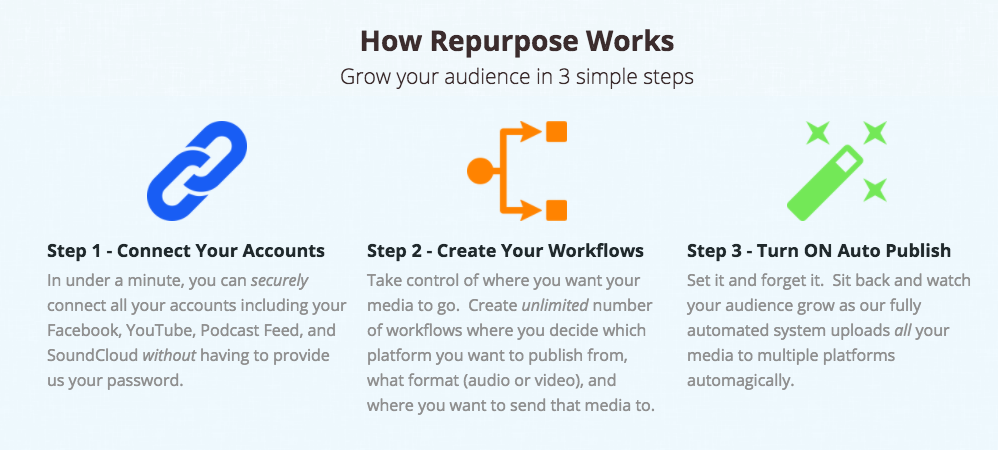
And Repurpose into the mix – it automatically converts your podcast to a video and shares to the most popular sites like YouTube and Facebook – and you have your bases covered.

how repurposing content works

Medium is a Good Platform for SaaS Business

Republishing your 5-star content on Medium can give you a big traffic and exposure boost.

And you’re literally just republishing content without making any changes (unless you want to, of course).

And before you start to worry about the dreaded “duplicate content penalty” from Google, don’t. It’s a myth. It doesn’t exist.

Medium boasts 60 million monthly readers, 140,000 new stories each week, and dozens of topics and categories.

Sign up, get started, and get sharing.

Think of it as half social network and half writing platform. It’s the best of both worlds.

Benjamin Hardy went from zero to 50,000 subscribers using Medium in only 16 months. How’s that sound?

Don’t Forget to Republish Older Posts

Finally, you don’t want to neglect your older posts.

Just because they’ve fallen off the radar, doesn’t mean they’re worthless. High quality, evergreen content can be reposted to tremendous effect.

We’ve already mentioned the short life span on a typical social media post.

The harsh reality is that most people won’t see it the first time around.

Share it again though, and you’ve increased the eyes on it. Share a third time, and it’s still more.

Reposting your content on a regular schedule will capture a bigger audience for it, reach people in different time zones, and generally increase your traffic.

Some studies have shown it’s possible to get 75% of the engagement of the original post. What’s not to like?

So share it. Share it again later that day, the next day, next week, next month, and two months from now. Experiment with the best times to share on different platforms. Use a scheduler like Buffer or Hootsuite to do it all for you.

You’ve already put in the effort. Don’t let it go to waste.

Conclusion

Your content is the heart of your marketing. Make it work for you by using a consistent repurpose and reschedule plan.

“Create less, promote more.” ~Salma Jafri

Everything can be repurposed into something else.

Old is new again.

The less time you spend on creating and the more time you spend on promoting, the higher the return you’ll see on content marketing.

You don’t need to reinvent the wheel every time you need to move something from Point A to Point B.

You might need to change it up a bit – size of wheel, number of wheels, material of wheel – but it’s still fundamentally the same thing.

The same goes for your content.

Slide deck into video. Podcast into transcript. Blog series into webinar. Data into infographic. The possibilities are endless.

Have you tried repurposing your best content? What strategies and tools have you tried? Leave your comments below:

About the Author: Neil Patel is the cofounder of Neil Patel Digital.

Reverse Phone - People Search - Email Search - Public Records - Criminal Records. Best Data, Conversions, And Customer Suppor

Friday, April 20, 2018

Marketing Lessons Learned from 16 Years of Building Moz - Whiteboard Friday

Something every woman should know - WHY MEN LIE!

Posted by randfish

The lessons Rand has learned from building and growing Moz are almost old enough to drive. From marketing flywheels versus growth hacks, to product launch timing, to knowing your audience intimately, Rand shares his best advice from a decade and a half of marketing Moz in today's edition of Whiteboard Friday.

Marketing Lessons Learned from 16 Years of Building Moz

Click on the whiteboard image above to open a high-resolution version in a new tab!

Video Transcription

Howdy, Moz fans, and welcome to another edition of Whiteboard Friday. This week we are going to chat about some of the big lessons learned for me personally building this company, building Moz over the last 16, 17 years.

Back in February, I left the company full-time. I'm still the Chairman of the Board and contribute in some ways, including an occasional Whiteboard Friday here and there. But what I wanted to do as part of this book that I've written, that's just coming out April 24th, Lost and Founder, is talk about some of the elements in there, maybe even give you a sneak peek.

If you're thinking, "Well, what are the two or three chapters that are super relevant to me?" let me try and walk you through a little bit of what I feel like I've taken away and what I'm going to change going forward, especially stuff that's applicable to those of us in web marketing, in SEO, and in broader marketing.

Marketing flywheels > growth hacks

First off, marketing flywheels, in my experience, almost always beat growth hacks. I know that growth hacks are trendy in the last few years, especially in the startup and technology worlds. There's been this sort of search for the next big growth hack that's going to transform our business. But I've got to be honest with you. Not just here at Moz, but in all of the companies that I've had experience with as a marketer, this tends to be what that looks like when it's implemented.

So folks will find a hack. They'll find some trick that works for a little while, and it results in this type of a spike in their traffic, their conversions, their success metrics of whatever kind. So they've discovered a way to game Facebook or they found this new black hat trick or they found this great conversion device. Whatever it is, it's short term and short lasting. Why is this? It tends to be because of something Andrew Chen calls — and I'll use his euphemism here — it's called the "Law of Shitty Click-through Rates," which essentially says that over time, as people get experienced with a sort of marketing trend, they become immune to its effects.

Marketing Lessons Learned from 16 Years of Building Moz - Whiteboard Friday

You can see this in anything that sort of tries to hack at consciousness or take advantage of psychological biases. So you get this pattern of hack, hack, hack, hack, and then none of the hacks you're doing work anymore. Even if you have a tremendously successful one, even if this is six months in length, it tends to be the case that, over time, those diminish and decline.

Conversely, a marketing flywheel is something that you build that generates inertia and energy, such that each effort and piece of energy that you put into it helps it spin faster and faster, and it carries through. It takes less energy to turn it around again and again in the future after you've got it up and spinning. This is how a lot of great marketing works. You build a brand. You build your audience. They come to you. They help it amplify. They bring more and more people back. In the web marketing world, this works really well too.

Marketing Lessons Learned from 16 Years of Building Moz - Whiteboard Friday

So most of you are familiar with Moz's flywheel, but I'll try and give it a rough explanation here. We start down here with content ideas that we get from spending lots of time with SEOs. We do keyword research, and we optimize these posts, including look at Whiteboard Friday itself.

What do we do with Whiteboard Friday? You're watching this video, but you'll also see the transcript below. You'll see the podcast version from SoundCloud so that you can listen to the text rather than watch me if you can do audio only for some reason. Each of these little images have been cut out and placed into the text below so that someone who's searching in Google images might find some of these and find their way to Whiteboard Friday. A few months after it goes up here, hosted with Wistia on Moz, it will be put up on YouTube.com so that people can find it there.

So we've done all these sorts of things to optimize these posts. We publish them, and then we earn amplification through all the channels that we have — email, social media, certainly search engines are a big one for us. Then we grow our reach for next time.

Early in the days, early in Moz's history, when I was first publishing, I was writing every blog post myself for many, many years. This was tremendously difficult. We weren't getting much reach. Now, it's an engine that turns on its own. So each time we do it, we earn more SEO ranking ability, more links, more other positive ranking signals. The next time we publish content, it has an even better chance of doing well. So Moz's flywheel keeps spinning, keeps getting faster and faster, and it's easier and easier. Each time I film Whiteboard Friday, I'm a little more experienced. I've gotten a little better at it.

Flywheels come in many different forms

Flywheels come in a lot of forms. It's not just the classic content and SEO one that we're describing here, although I know many of you who watch Whiteboard Friday probably use something similar. But press and PR is a big one that many folks use. I know companies that are built on primarily event marketing, and they have that same flywheel going for them. In advertising, folks have found these, in influencer-focused marketing flywheels, and community and user-generated content to build flywheels. All of these are ways to do that.

Find friction in your flywheels

If and when you find friction in your flywheel, like I did back in my early days, that's when a hack is really helpful. If you can get a hack going to grow reach for next time, for example, in my early days, this was all about doing outreach to folks in the SEO space who were already influential, getting them to pay attention and help amplify Moz's content. That was the hack that I needed. Essentially, it was a combination of the Beginner's Guide to SEO and the Search Ranking Factors document, which I've described here. But that really helped grow reach for next time and made this flywheel start spinning in the way that we wanted. So I would urge you to favor flywheels over hacks.

Marketing an MVP is hard

Second one, marketing an MVP kind of sucks. It's just awful. Great products are rarely minimum viable products. The MVP is a wonderful way to build. I really, really like what Eric Ries has done with that movement, where he's taken this concept of build the smallest possible thing you can that still solves the user's problem, the customer's problem and launch that so that you can learn and iterate from it.

I just have one complaint, which is if you do that publicly, if you launch your MVP publicly and you're already a brand that's well known, you really hurt your reputation. No one ever thinks this. No one ever thinks, "Gosh, you know, Moz launched their first version of new tool X. It's pretty terrible, but I can see how, with a few years of work, it's going to be an amazing product. I really believe in them." No one thinks that way.

What do you think? You think, "Moz launched this product. Why did they launch it? It's kind of terrible. Are they going downhill? Do they suck now? Maybe I should I trust their other tools less." That's how most people think when it comes to an MVP, and that's why it's so dangerous.

Marketing Lessons Learned from 16 Years of Building Moz - Whiteboard Friday

So I made this silly chart here. But if the quality goes from crap to best in class and the amplification worthiness goes from zero to viral, it tends to be the case that most MVPs are launching way down here, when they're barely good enough and thus have almost no amplification potential and really can't do much for your marketing other than harm it.

If you instead build it internally, build that MVP internally, test with your beta group, and wait until it gets all the way up to this quality level of, "Wow, that's really good," and lots of people who are using it say, "Gosh, I couldn't live without this. I want to share it with my friends. I want to tell everyone about this. Is it okay to tell people yet?" Maybe it's starting to leak. Now, you're up here. Now, your launch can really do something. We have seen exactly that happen many, many times here at Moz with both MVPs and MVPs where we sat on them and waited. I talk about some of these in the book.

MVPs, great to test internally with a private group. They're also fine if you're really early stage and no one has heard of you. But MVPs can seriously drag down reputation and perception of a brand's quality and equity, which is why I generally recommend against them, especially for marketing.

Living the lives of your customer/audience is a startup + marketing cheat code

Last, but not least, living the lives of your customers or your audience is a cheat code. It is a marketing and startup cheat code. One of the best things that I have ever done is to say, "You know what? I am not going to sequester myself in my office dreaming up this great thing I think we should build or I think that we should do. Instead, I'm going to spend real time with our customers."

Marketing Lessons Learned from 16 Years of Building Moz - Whiteboard Friday

So you might remember, at the end of 2013, I did this crazy project with my friend, Wil Reynolds, who runs Seer Interactive. They're an SEO agency based here in the United States, in Philadelphia and San Diego. They do a lot more than SEO. Wil and I traded houses. We traded lives. We traded email accounts. I can't tell you how weird it is answering somebody's email, replying to Wil's mom and being like, "Oh, Mrs. Reynolds, this is actually Rand. Your son, Wil, is answering my email off in Seattle and living in my apartment."

Marketing Lessons Learned from 16 Years of Building Moz - Whiteboard Friday

That experience was transformational for me, especially after having gone through the pain of building something that I had conceptualized myself but hadn't validated and hadn't even come up with the idea from real problems that real people were facing. I had come up with it based on what I thought could grow the company. I seriously dislike ideas that come from that perspective now.

So since then, I just try not to assume. I try not to assume that I know what people want. When we film a Whiteboard Friday, it is almost always on a topic that someone I have met and talked to either over email or over Twitter or in person at an event or a conference, we've had a conversation in person. They've said, "I'm struggling with this." I go, "I can make a Whiteboard Friday to help them with that." That's where these content ideas come from.

When I spend time with people doing their job, I was just in San Diego a little while ago meeting with a couple of agencies down there, spending time in their offices showing off a new links tool, getting all their feedback, seeing what they do with Open Site Explorer and Ahrefs and Majestic and doing their work with them, trying to go through the process that they go through and actually experiencing their pain points. I think this right here is the product and marketing cheat code. If you spend time with your audience, experiencing their pain points, the copy you write, what you design, where you place it, who you try and get to influence and amplify it, how you serve them, whether that's through content or through advertising or through events, or whatever kind of marketing you're doing, will improve if you live the lives of your customers and their influencers.

Whatever kind of marketing you're doing will improve if you live the lives of your customers and their influencers.

All right, everyone. Hope you've enjoyed this edition of Whiteboard Friday. If you have feedback on this or if you've read the book and checked that out and you liked it or didn't like it, please, I would love to hear from you. I look forward to your comments. We'll see you again next week for another edition of Whiteboard Friday. Take care.

Video transcription by Speechpad.com


Sign up for The Moz Top 10, a semimonthly mailer updating you on the top ten hottest pieces of SEO news, tips, and rad links uncovered by the Moz team. Think of it as your exclusive digest of stuff you don't have time to hunt down but want to read!

Reverse Phone - People Search - Email Search - Public Records - Criminal Records. Best Data, Conversions, And Customer Suppor

Tuesday, April 17, 2018

LinkedIn cofounder Eric Ly launches ICOHub to eliminate ICO scammers

Something every woman should know - WHY MEN LIE!


EXCLUSIVE: Eric Ly is on a mission. A cofounder and former CTO of LinkedIn, Ly recently launched Hub, Human Trust Protocol to help strangers safely interact on the internet and build digital reputations based on their transaction history. Today, Hub has announced ICOHub, a proof of concept reputation system for ICOs. What does ICOHub do? It allows…Read More

Reverse Phone - People Search - Email Search - Public Records - Criminal Records. Best Data, Conversions, And Customer Suppor

Enterprise Local SEO is Different: A Checklist, a Mindset

Something every woman should know - WHY MEN LIE!

Posted by MiriamEllis

Image credit: Abraham Williams

If you’re marketing big brands with hundreds or thousands of locations, are you certain you’re getting model-appropriate local SEO information from your favorite industry sources?

Is your enterprise checking off not just technical basics, but hyperlocalized research to strengthen its entrance into new markets?

Before I started working for Moz in in 2010, the bulk of my local SEO experience had been with small-to-medium business models. Naturally, the advice I was able to offer back then was limited by the scope of my work. But then came Moz Local, and the opportunity to learn more about the more complex needs of valued enterprise customers like Crate & Barrel with more than 170 locations, PAPYRUS with 400, or Bridgestone Corporation with 2000+.

Now, when I’m thumbing through industry tips and tactics, I’m better able to identify when a recommended practice is stemming from an SMB mindset and falling short of enterprise realities, or is truly applicable to all business models. My goal for this post is to offer:

  • Examples of commonly encountered advice that isn’t really best for big brands
  • An Enterprise Local SEO Checklist to help you shape strategy for present campaigns, or ready your agency to pursue relationships with bigger dream clients
  • A state-to-enterprise wireframe for initial hyperlocal marketing research

Not everything you read is for enterprises

When a brand is small, like a single location, family-owned retail shop, it’s likely that a single person at the company can manage the business’ Local SEO, with some free education and a few helpful tools. Large, multi-location brands, just by dint of organizational complexities, are different. Before they even get down to the nitty gritty of building citations, enterprises have to solve for:

  • Standardizing data across hundreds or thousands of locations
  • Franchise relationships that can muddy who controls which data and assets
  • Designating staff to actually manage data and execute initiatives, and building bridges between teams that must work in concert to meet goals
  • Scaling everything from listings management, to site architecture, to content dev
  • Dealing with a hierarchy of reports of bad data from the retail location level up to corporate

I am barely scratching the surface here. In a nutshell, the scale of the organization and the scope of the multi-location brand can turn a task that would be simple for Mom-and-Pop into a major, company-wide challenge. And I think it adds to the challenge when published advice for SMBs isn’t labeled as such. Over the years, three common tips I’ve encountered with questionable or no applicability to enterprises include:

Not-for-enterprises #1: Link all your local business listings to your homepage

This is sometimes offered as a suggestion to boost local rankings, because website home pages typically have more authority than location landing pages do. But in the enterprise scenario, sending a consumer from a listing for his chosen location, to a homepage, and then expecting him to fool around with a menu or a store locator widget to finally reach a landing page for the location he’s already designated that he wanted is not respecting his user experience. It’s wasting his time. I consider this an unnecessary risk of conversions.

Simultaneously, failure to fully utilize location landing pages means that very little can be done to customize the website experience for each community and customer. Directly-linked-to landing pages can provide instant, persuasive proofs of local-ness, in the form of real local reviews, news about local sponsorships and events, special offers, regional product highlights, imagery and so much more that no corporate homepage can ever provide. Consider these statistics:

“According to a new study, when both brand and location-specific pages exist, 85% of all consumer engagement takes place on the local pages (e.g., Facebook Local Pages, local landing pages). A minority of impressions and engagement (15%) happen on national or brand pages.” - Local Search Association

In the large, multi-location scenario, it just isn’t putting the customer first to swap out a hoped-for ranking increase for a considerate, well-planned user experience.

Not-for-enterprises #2: Local business listings are a one-and-done deal

I find this advice particularly concerning. I don’t consider it true even for SMBs, and at the enterprise level, it’s simply false. It’s my guess that this suggestion stems from imagining a single local business. They create their Google My Business listing and build out perhaps 20–50 structured citations with good data. What could go wrong?

For starters, they may have forgotten that their business name was different 10 years ago. Oh, and they did move across town 5 years ago. And this old data is sitting somewhere in a major aggregator like Acxiom, and somehow due to the infamous vagaries of data flow, it ends up on Bing, and a Bing user gets confused and reports to Google that the new address is wrong on the GMB listing … and so on and so on. Between data flow and crowdsourced editing, a set-and-forget approach to local business listings is trouble waiting to happen.

Now multiply this by 1,000 business locations. And throw in that the enterprise opened two new stores yesterday and closed one. And that they just acquired a new chain and have to rebrand all its assets. And there seems to be something the matter with the phone number on 25 listings, because they’re getting agitated complaints at corporate. And they received 500 reviews last week on Google alone that have to be managed, and it seems one of their competitors is leaving them negative reviews. Whoa – there are 700 duplicate listings being reported by Moz Local! And the brand has 250 Google Questions & Answers queries to respond to this week. And someone just uploaded an image of a dumpster to their GMB listing in Santa Fe…

Not only do listings have to be built, they have to be monitored for data degradation, and managed for inevitable business events, responsiveness to consumers, and spam. It’s hard enough for SMBs to pull all of this off, but enterprises ignore this at their peril!

Not-for-enterprises #3: Just do X

Every time a new local search feature or best practice emerges, you’ll find publications saying “just do X” to implement. What I’ve learned from enterprises is that there is no “just” about it.

Case in point: in 2017, Google rolled out Google Posts, and as Joel Headley of healthcare practice growth platform PatientPop explained to me in a recent interview, his company had to quickly develop a solution that would enable thousands of customers to utilize this influential feature across hundreds of thousands of listings. PatientPop managed implementation in an astonishingly short time, but typically, at the enterprise level, each new rollout requires countless steps up and down the ladder. These could include achieving recognition of the new opportunity, approval to pursue it, designation of teams to work on it, possible acquisition of new assets to accomplish goals, implementation at scale, and the groundwork of tracking outcomes so that they can be reported to prove/disprove ROI from the effort.

Where small businesses can be relatively agile if they can find time to man-up to new features and strategies, enterprises can become dangerously bogged down by infrastructure and communications gaps. Even something as simple as hyperlocalizing content to the needs of a given community represents a significant undertaking.

The family-owned local hardware store already knows that the county fair is the biggest annual event in their area, and they’ve already got everything necessary to participate with a booth, run a contest, take photos, sponsor the tractor pull, earn links, and blog about it. For the hardware franchise with 3,000 stores, branch-to-corporate communication of the mere existence of the county fair, let alone gaining permission to market around it, will require multiple touches from the location to C-suites, and back again.

Checklist for enterprise local SEO preparedness

If you’re on the marketing team for an enterprise, or you run an agency and want to begin working with these larger, rewarding clients, you’ll be striving to put a checkmark in every box on the following checklist:

☑ Definition of success

We’ve determined which actions = success for our brand, whether this is increases for in-store traffic, sales, phone calls, bookings, or some other metric. When we see growth in these KPIs, it will affirm for us that our efforts are creating real success.

☑ Designation of roles

We’ve defined who will be responsible for all tasks relating to the local search marketing of our business. We’ve equipped these team members with all necessary permissions, granted access to key documentation, have organized workflows, and have created an environment for documentation of work.

☑ Canonical data

We’ve created a spreadsheet, approved and agreed upon by all major departments, that lists the standardized name, address, phone number, website URL, and hours of operation for each location of the company. Any variant information has been resolved into a single, agreed-upon data set for each location. This sheet has been shared with all stakeholders managing our local business listings, marketing, website and social outreach.

☑ Website optimization

Our keyword research findings are reflected in the tags and text of our website, including image optimization. Complete contact information for each of our locations is easily accessible on the site and is accurate. We’ve implemented proper markup, such as Schema or JSON-LD, to ensure that our data is as clear as possible to search engines.

☑ Website quality

Our website is easy to navigate and provides a good, usable experience for desktop, mobile and tablet users. We understand that the omni-channel search environment includes ambient search in cars, in homes, via voice. Our website doesn’t rely on technologies that exclude search engines or consumers. We’re putting our customer first.

☑ Tracking and analysis

We’ve implemented maximum controls for tracking and analyzing traffic to our website. We’re also ready to track and analyze other forms of marketing, such as clicks stemming from our Google My Business listings traffic being driven to our website by articles on third party sources, and content we’re sharing via social media.

☑ Publishing strategy

Our website features strong basic pages (Home, Contact, About, Testimonials/Reviews, Policy), we’ve built an excellent, optimized page for each of our core products/services and a quality, unique page for each of our locations. We have a clear strategy as to ongoing content publication, in the form of blog posts, white papers, case studies, social outreach, and other forms of content. We have plans for hyperlocalizing content to match regional culture and needs.

☑ Store locator

We’ve implemented a store locator widget to connect our website’s users to the set of location landing pages we’ve built to thoughtfully meet the needs of specific communities. We’ve also created an HTML version of a menu linking to all of these landing pages to ensure search engines can discover and index them.

☑ Local link building

We’re building the authority of our brand via the links we earn from the most authoritative sources. We’re actively seeking intelligent link building opportunities for each of our locations, reflective of our industry, but also of each branch’s unique geography.

☑ Guideline compliance

We’ve assessed that each of the locations our business plans to build local listings for complies with the Guidelines for Representing Your Business on Google. Each location is a genuine physical location (not a virtual office or PO box) and conducts face-to-face business with consumers, either at our locations or at customers’ locations. We’re compliant with Google’s rules for the naming of each location, and, if appropriate, we understand how to handle listing multi-department and multi-practitioner businesses. None of our Google My Business listings is at risk for suspension due to basic guideline violations. We’ve learned how to avoid every possible local SEO pitfall.

☑ Full Google My Business engagement

We’re making maximum use of all available Google My Business features that can assist us in achieving our goals. This could include Google Posts, Questions & Answers, Reviews, Photos, Messaging, Booking, Local Service Ads, and other emerging features.

☑ Local listing development

We’re using software like Moz Local to scale creation of our local listings on the major aggregators (Infogroup, Acxiom, Localeze and Factual) as well as key directories like Superpages and Citysearch. We’re confident that our accurate, consistent data is being distributed to these most important platforms.

☑ Local listing monitoring

We know that local listings aren’t a set-and-forget asset and are taking advantage of the ongoing monitoring SaaS provides, increasing our confidence in the continued accuracy of our data. We’re aware that, if left unmanaged, local business listing data can degrade over time, due to inputs from various, non-authoritative third parties as well as normal data flow across platforms.

☑ In-store strategy

All public-facing staff are equipped with the necessary training to implement our brand’s customer service policy, answer FAQs or escalate them via a clear hierarchy, resolving complaints before they become negative online reviews. We have installed in-store signage or other materials to actively invite consumer complaints in-person, via an after-hours helpline or text message to ensure we are making maximum effort to build and defend our strong reputation.

☑ Review acquisition

We’ve developed a clear strategy for acquiring reviews on an ongoing basis on the review sites we’ve deemed to be most important to our brand. We’re compliant with the guidelines of each platform on which we’re earning reviews. We’re building website-based reviews and testimonials, too.

☑ Review monitoring & response

We’re monitoring all incoming reviews to identify both positive and negative emerging sentiment trends at specific locations and we’re conversant with Net Promoter Score. We’ve created a process for responding with gratitude to positive reviews. We’re defending our reputation and revenue by responding to negative reviews in ways that keep customers who complain instead of losing them, to avoid needless drain of new customer acquisition spend. Our responses are building a positive impression of our brand. We’ve built or acquired solutions to manage reviews at scale.

☑ Local PR

Each location of our brand has been empowered to build a local footprint in the community it serves, customizing outreach to match community culture. We’re exploring sponsorships, scholarships, workshops, conferences, news opportunities, and other forms of participation that will build our brand via online links and social mentions as well as offline WOM marketing. We’re continuously developing cohesive online/offline outreach for maximum impact on brand recognition, rankings, reputation, and revenue.

☑ Social media

We’ve identified the social platforms that are most popular with our consumer base and a best fit for our brand. We’re practicing ongoing social listening to catch and address positive and negative sentiment trends as they arise. We’ve committed to a social mindset based on sharing rather than the hard sell.

☑ Spam-ready

We’re aware that our brand, our listings, and our reviews may be subject to spam, and we know what options are available for reporting it. We’re also prepared to detect when the spammy behaviors of competitors (such as fake addresses, fake negative/positive reviews, or keyword stuffing of listings) are giving them an unfair advantage in our markets, and have a methodology for escalating reports of guideline violations.

☑ Paid media

We’re investing wisely in both on-and-offline paid media and carefully tracking and analyzing the outcomes of online pay-per-click, radio, TV, billboards, and phone sales strategy. We’re exploring new opportunities, as appropriate and as they emerge, like Google Local Service Ads.

☑ Build/buy

When any new functionality (like Google Posts or Google Q&A) needs to be managed at scale, we have a process for determining whether we need to build or acquire new technology. We know we have to weigh the pros/cons of developing in-house or buying ready-made solutions.

☑ Competitive difference-maker

Once you’ve checked off all of the above elements, you’re ready to move forward towards identifying a USP for your brand that no one else in your market has explored. Be it a tool, widget, app, video marketing campaign, newsworthy acquisition, new partnership, or some other asset, this venture will require deep competitive and market research to discover a need that has yet to be filled well by your competitors. If your business can serve this need, it can set your brand apart for years to come.

Free advice, specifically for local enterprises

It’s asserted that customers may forget what you say, but they’ll never forget how you make them feel.

Call me a Californian, but I continue to be amazed by automotive TV spots that show large trucks driving through beautiful creeks (thanks for tearing up precious riparian habitat during our state-wide drought) and across pristine arctic snowfields (instantly reminding me of climate change). Meanwhile, my family have become Tesla-spotters, seeing that “zero emissions” messaging on the tail of every luxury eco-vehicle that passes us by. As consumers, we know how we feel.

Technical and organizational considerations aside, this is where I see one of the greatest risks posed to the local enterprise structure. Insensitivity at a regional or hyperlocal level -- the failure to research customer needs with the intention of meeting them — has been responsible for some of the most startling bad news for enterprises in recent recall. From ignored negative reviews across fast food franchises, to the downsizing of multiple apparel retailers who have been unable to stake a clear claim in the shifting shopping environment, brands that aren’t successful at generating positive consumer “feelings” may need to reevaluate not just their local search marketing mindset, but their basic identity.

If this sounds uncomfortable or risky, consider that we are seeing a rising trend in CEOs taking stands on issues of national import in America. This is about feelings. Consumers are coming to expect this, and it feeds down to the local level.

Hyperlocalized market research

If your brand is considering opening a new branch in a new state or city, you’ll be creating profiles as part of your research. These could be based on everything from reading local news to conducting formal surveys. If I were to do something like this for my part of California, these are the factors I’d be highlighting about the region:

California

Enterprises

We’ve been blasted by drought and wildfire. In 2017, alone, we went through 9,133 fires. On a positive note, Indigenous thought-leadership is beginning to be re-implemented in some areas to solve our worst ecological problems (water scarcity, salmon loss, absence of traditional forestry practices).

Can your brand help conserve water, re-house thousands of homeless residents, fund mental health services despite budget cuts, make legal services affordable, provide solutions for increased future safety? What are your green practices? Are you helping to forward ecological recovery efforts at a tribal, city or state level?

We’re grumbling more loudly about tech gentrification. If you live in Mississippi, sit down for this. The average home price in your state is $199,028. In my part of California, it’s $825,000. In San Francisco, specifically, you’ll need $1.2 million dollars to buy a tiny studio apartment... if you can find one. While causes are complex, people I talk with generally blame Silicon Valley.

Can your brand be part of this conversation? If not, you’re not really addressing what is on statewide consumers’ minds. Particularly if you’re marketing a tech-oriented company, taking the housing crisis seriously and coming up with solutions for even a modest amount of relief would certainly be positive and newsworthy.

We’ve turned to online shopping for an interesting variety of reasons. And it’s not just because we’re techie hipsters. The retail inventory in big cities (San Francisco) can be overwhelming to sort through, and in small towns (Cloverdale), the shopping options are too few to meet our basic and luxury desires.

Can your brand thrive in the gaps? If you’re located in a metro area, you may need to offer personal assistance to help consumers filter through options. If you’ve got a location somewhere near small towns, strategies like same-day delivery could help you remain competitive.


We’ve got our Hispanic/Latino identity back. Our architecture, city and street names are daily reminders that California has a lot more to do with Mexico than it ever did with the Mayflower. We may have become part of the U.S. in 1850, but pay more attention to 2014 — the year that our Hispanic/Latino community became the state’s largest ethnic group. This is one of the most vibrant happenings here. At the same time, our governor has declared us a sanctuary state for immigrants, and we’re being sued for it by the Justice Department.

Can your brand celebrate our state’s diversity? If you’re doing business in California today, you’ll need bilingual marketing, staff, and in-store amenities. Pew Research publishes ongoing data about the Hispanic/Latino segment of our population. What is your brand doing to ensure that these customers feel truly served?

We’re politically diverse. Our single state is roughly the same size as Sweden, and we truly do run the political gamut from A–Z here. Are citizens removing a man-made dam heroically restoring ecology or getting in the way of commerce? You’ll find voices on every side.

Can your brand take the risk of publicizing its honest core values? If so, you are guaranteed to win and lose Californian customers, so do your research and be prepared to own your stance. Know that at a regional level, communities differ greatly. Those TV ads that show trucks running roughshod through fragile ecosystems may fly in some cities and be viewed with extreme distaste in others.


Money is top of mind. More than ⅓ of Californians have zero savings. Over½ of the citizens have less than $1000 in savings. We invest more in Welfare than the next two states combined. And while our state has the highest proportion of resident billionaires, they are vastly outnumbered by citizens who are continuously anxious about struggling to get by. Purchasing decisions are seldom easy.

Can your brand employ a significant number of residents and pay them a living wage? Could your entry into a new market lift poverty in a town and provide better financial security? This would be newsworthy! Have ideas for lowering prices? You’ll get some attention there, too.

Obviously, I’m painting with broad strokes here, just touching on some of the key points that your enterprise would need to consider in determining to commence operations in any city or state. Why does this matter? Because the hyperlocalization of marketing is on the rise, and to engage with a community, you must first understand it.

Every month, I see businesses shutter because someone failed to apprehend true local demand. Did that bank pick a good location for a new branch? Yes — the next branch is on the other side of the city. Will the new location of the taco franchise remain open? No — it’s already sitting empty while the beloved taco wagon down the street has a line that spills out of its parking lot all night long.

Summing up

"What helps people, helps business." - Leo Burnett

The checklist in this post can help you create an enterprise-appropriate strategy for well-organized local search marketing, and it’s my hope that you’ll evaluate all SEO advice for its fitness to your model. These are the basic necessities. But where you go from there is the exciting part. The creative solutions you find to meet the specific wants and needs of individualized service communities could spell out the longevity of your brand’s success.


Sign up for The Moz Top 10, a semimonthly mailer updating you on the top ten hottest pieces of SEO news, tips, and rad links uncovered by the Moz team. Think of it as your exclusive digest of stuff you don't have time to hunt down but want to read!

Reverse Phone - People Search - Email Search - Public Records - Criminal Records. Best Data, Conversions, And Customer Suppor

Tuesday, April 10, 2018

Womply Launches Womply Boost to Help Small Businesses Attract More Customers From Local Internet Searches

Something every woman should know - WHY MEN LIE!


PRESS RELEASE: Cloud-based software platform empowers business owners to take control of their online business reputation on popular sites like Yelp, Google My Business, Facebook, and TripAdvisor. SAN FRANCISCO–(BUSINESS WIRE)–April 10, 2018– Womply, the leader in front office software for small- and medium-sized businesses (SMBs)…Read More

Reverse Phone - People Search - Email Search - Public Records - Criminal Records. Best Data, Conversions, And Customer Suppor